Yuxisaurus kopchicki: Asia’s Earliest Armored Dinosaur Explained
A stocky, spine-covered plant-eater from Early Jurassic Yunnan, and the first valid armored dinosaur species described from Asia.
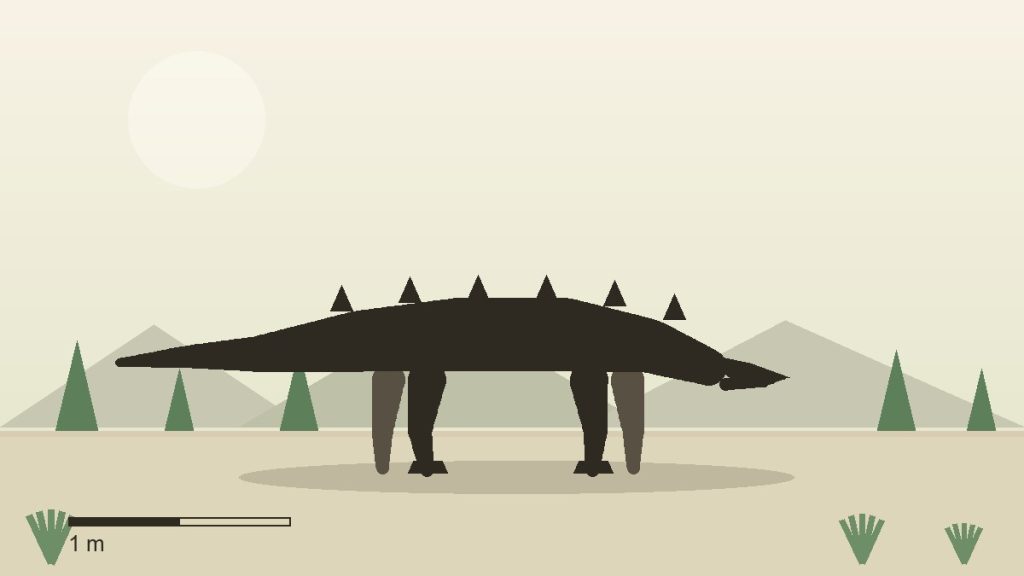
Every Stegosaurus plate and every Ankylosaurus tail club traces back to small, unassuming plant-eaters that first evolved body armor near the dawn of the Jurassic. For decades, Asia’s chapter of that origin story was blank — a few undiagnostic jaw scraps and nothing more. Then a partial skeleton from Yunnan Province, China, changed everything: Yuxisaurus kopchicki, a stocky, spine-covered herbivore about 190 to 174 million years old and the first Early Jurassic armored dinosaur from Asia complete enough to earn a scientific name.
This is the story of what Yuxisaurus was, what its bones actually show, why headlines call it “Asia’s oldest armored dinosaur,” and where that superlative needs careful qualification.
Meet Yuxisaurus kopchicki: The “Yuxi Lizard”
Yuxisaurus kopchicki (pronounced “yoo-shee-SOR-us kop-CHIK-ee”) is an early-diverging thyreophoran — a member of Thyreophora, the “shield-bearers,” the great dinosaur lineage that later produced stegosaurs and ankylosaurs. The genus name combines Yuxi, the prefecture in Yunnan Province where the fossil was found, with the Greek sauros (lizard). The species name honors the American biologist John J. Kopchick.
The animal was formally described on March 15, 2022, by Xi Yao, Paul M. Barrett, Lei Yang, Xing Xu, and Shundong Bi in the open-access journal eLife, on the basis of a single associated partial skeleton. It lived during the Early Jurassic, in the late Sinemurian to Toarcian stages — roughly 192 to 174 million years ago, some 100 million years before Tyrannosaurus rex. Our guide to the three Mesozoic periods puts that deep-Early-Jurassic world in context.
The paper’s central claim, and the source of the headlines, is precise: Yuxisaurus is the first valid thyreophoran described from the Early Jurassic of Asia. That word “valid” carries the entire weight of the story, as we will see.
How It Was Found and Named
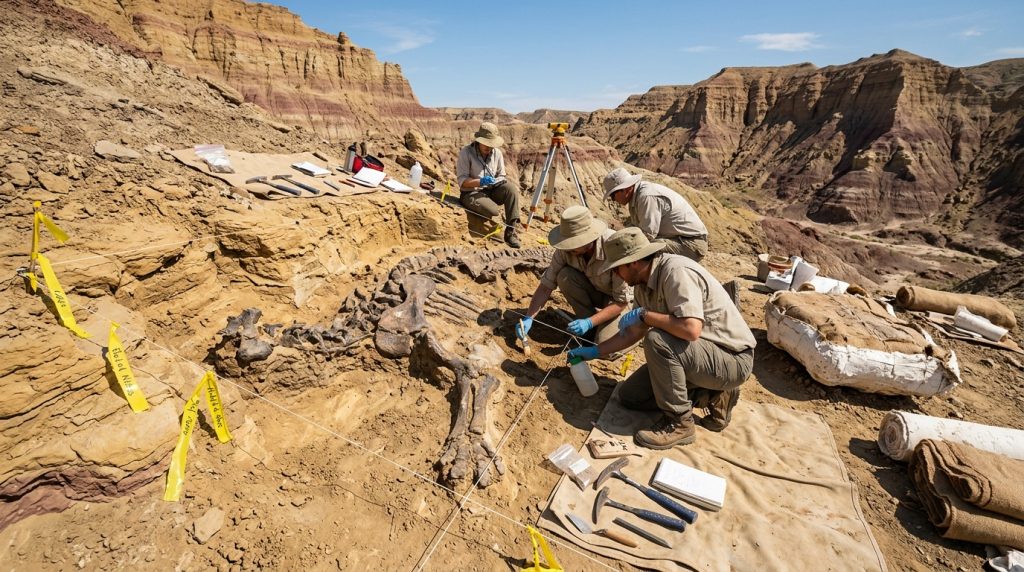
The holotype skeleton, catalogued as CVEB 21701 and housed at the Centre for Vertebrate Evolutionary Biology of Yunnan University, was recovered by Chinese field teams from the upper part of the Fengjiahe Formation near Jiaojiadian village in Yimen County, Yunnan Province, southwestern China. The Fengjiahe Formation is better known for long-necked sauropods and their early relatives, which dominate its dinosaur fauna; an armored dinosaur was an unexpected addition to the ecosystem.
The name first surfaced in a late-2021 preprint, then received formal publication in eLife in March 2022 with a ZooBank registration, the official ledger of new zoological names. What made the specimen name-worthy was not its completeness alone but its diagnosability: the researchers identified numerous anatomical features found in no other thyreophoran — details of the braincase, the lower jaw joint, neck vertebrae, and thigh bone — plus a unique combination of traits separating it from every known relative. In taxonomy, a new name must be anchored to features that distinguish the animal, and CVEB 21701 cleared that bar where earlier Chinese finds had failed.
What the Fossils Actually Include (and What’s Missing)
Honest reporting starts with an inventory. The known material of Yuxisaurus kopchicki is one associated partial skeleton comprising:
- the right-hand side of the skull (fused upper jaw, cheek, and snout bones), the braincase, part of the skull roof, and rear portions of both lower jaws;
- four articulated neck vertebrae and five back vertebrae, including a massive, trapezoidal axis (the second neck vertebra);
- shoulder elements, a well-preserved right upper arm bone (humerus) about 345 millimetres long, and the lower end of the left thigh bone;
- more than 120 osteoderms — the bony armor plates, spines, and ossicles embedded in the skin.

What is missing matters just as much: most of the snout and teeth-bearing jaw front, the hips, nearly all of the tail, the hands, and the feet. No skin impressions, no stomach contents, no trackways. Everything about diet, posture detail, color, and behavior beyond the bones is inference — grounded inference, but inference.
One encouraging detail: the skull bones are extensively fused and the vertebral growth seams fully closed, which in dinosaurs typically indicates an adult animal. The describers conclude the holotype was probably mature, so its stocky proportions are unlikely to be a juvenile growth stage.
Armor: What “Armored Dinosaur” Actually Means
“Armored dinosaur” is not a formal group but a convenient description of thyreophorans, the ornithischian (“bird-hipped”) lineage defined by bony armor grown directly in the skin. These structures are called osteoderms — literally “bone-skin” — and they take many forms: keeled scutes, conical spines, pebble-like ossicles, and in later ankylosaurs, fused neck half-rings and tail clubs. Because osteoderms fossilize readily and their shapes vary between species, they are among the most useful identification tools paleontologists have.
Yuxisaurus preserves more than 120 of them in a range of shapes, including keeled plates and sharp spines that the eLife digest describes as covering a medium-sized animal “much sturdier and stockier than its immediate relatives.” The armor is the single most diagnostic thing about the find: it immediately identifies the animal as a thyreophoran, while its distinctive arrangement separates Yuxisaurus from contemporaries such as Germany’s Emausaurus and Britain’s Scelidosaurus.
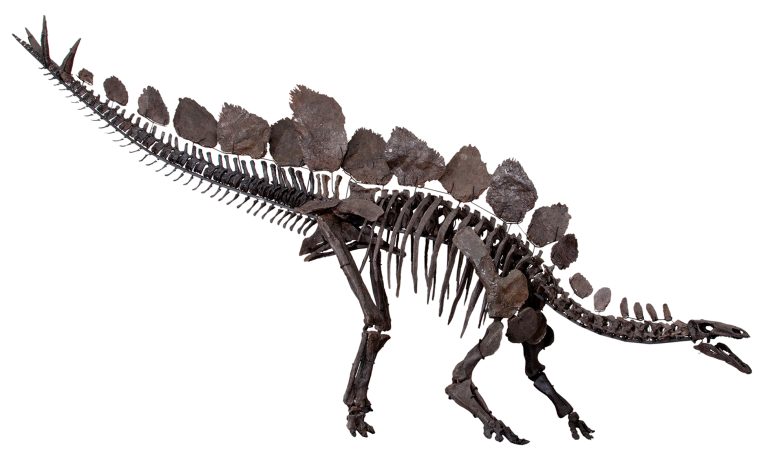
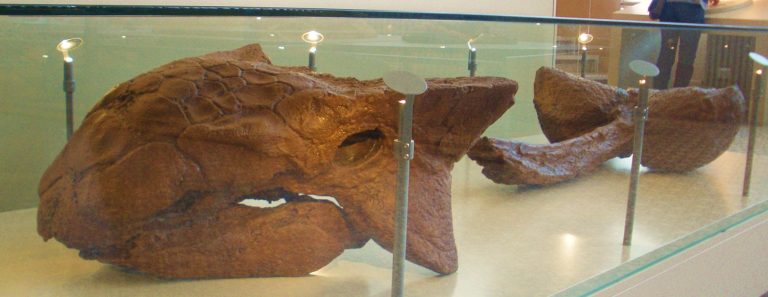
Compare that modest Early Jurassic panoply with the end products of the lineage: Stegosaurus stenops, with its alternating back plates and spiked tail, or Ankylosaurus magniventris, the tank-like “walking coffee table” sheathed in bony shields. Yuxisaurus shows the experimental early phase — armor present and diverse, but not yet organized into the spectacular arrays of its distant cousins. How scientists read such skin structures is explored further in our article on feathers, scales, and color in paleoart.
Size, Diet, and Lifestyle: Reading Between the Bones
The describers call Yuxisaurus “medium-sized,” and deliberately so: with no complete limb or backbone, a precise body length cannot be measured. Its skull is larger than those of Scutellosaurus, Emausaurus, and Scelidosaurus, and its fore- and hindlimbs are considerably more robust — a heavily built animal on the general scale of its ~3-to-4-metre relatives, but stockier. Any exact figure you encounter online is an approximation layered on that comparison, not a measurement from the fossil.
Diet is a safer inference: every known thyreophoran was a plant-eater, and Yuxisaurus almost certainly browsed low vegetation with its small head held near the ground. Posture follows from the limbs. The thick, columnar fore- and hindlimbs resemble those of later quadrupedal stegosaurs and ankylosaurs far more than the lightly built arms of facultatively bipedal relatives, so researchers reconstruct Yuxisaurus as walking on all fours — a reasonable conclusion, though one a future complete skeleton could refine.
Behavior, speed, coloration, social life: unknown, and likely to remain so until more material surfaces. The Yunnan badlands may yet oblige — the describers note that the region is only beginning to yield its Early Jurassic herbivores.
Its Place in Dinosaur Evolution: Near the Fork, Not Above It
Phylogenetic analysis places Yuxisaurus very close to one of the most important junctions in ornithischian evolution: the split between the lineage leading to stegosaurs and the lineage leading to ankylosaurs (together, Eurypoda). Depending on the dataset, it falls out as the closest relative of Germany’s Emausaurus, or as the next branch out from the group containing Scelidosaurus plus all eurypodans.
Two points about this placement deserve emphasis. First, its heavy, ankylosaur-like build evolved independently of true ankylosaurs — the analysis nests it outside both stegosaurs and ankylosaurs, so the resemblance is convergence or a shared ancestral tendency, not direct ancestry. Second, Yuxisaurus was nobody’s ancestor in any demonstrable sense: it sits near the fork in the road, close to the common ancestry of the two great armored lineages, but phylogenetic trees identify cousins, not grandparents. Saying it is “close to the common ancestor of stegosaurs and ankylosaurs” (as co-author Paul Barrett puts it) is accurate; calling it the ancestor is not.
The broader signal is biogeographic. Finding an early-diverging thyreophoran in Early Jurassic China — the easternmost such occurrence in Laurasia at the time — confirms that armored dinosaurs had already spread across the northern hemisphere within a few million years of the group’s first appearance around 200 million years ago. As Barrett notes, they achieved a worldwide distribution remarkably early, and subsequent finds keep complicating any simple northern-origin story.
What “Asia’s Oldest Armored Dinosaur” Really Means
Now the necessary qualification, stated plainly. The accurate scientific claim is this: Yuxisaurus kopchicki is the first valid thyreophoran species described from the Early Jurassic of Asia, and the earliest well-preserved armored dinosaur found on the continent to date. Each italicized word does load-bearing work:
- Valid — Two earlier Chinese names exist from the Early Jurassic Lufeng Formation, Bienosaurus and Tatisaurus, but both rest on scraps too fragmentary to diagnose. They are regarded as nomina dubia (dubious names). Armor-indicating fragments show thyreophorans were present, but no valid species could be recognized until Yuxisaurus.
- Described / found to date — “Oldest known” describes the current fossil record, not the actual first animal. An older Asian thyreophoran may be weathering out of a Yunnan hillside right now.
- Of Asia — Globally, Yuxisaurus was not the earliest armored dinosaur. It was contemporary with Emausaurus in Germany and Scelidosaurus in Britain, and possible unarmored near-relatives from Venezuela and South Africa approach 200 million years. The distinction is continental, not planetary.
So the working title’s “oldest” is defensible shorthand only with this context attached — which is why this article, and our published headline, frame it as the earliest valid and best-preserved Asian example rather than an unqualified record-holder.
Why This Chinese Discovery Matters (and What Remains Unknown)
Yuxisaurus matters for three reasons. First, it converts decades of tantalizing Asian fragments into a real, diagnosable animal, giving researchers their first solid data point for Early Jurassic thyreophoran anatomy east of Europe. Second, its unexpectedly stocky build and distinctive armor show that early armored dinosaurs were already experimenting with body shapes and ecologies — morphological diversity arrived millions of years earlier than the classic Late Jurassic menagerie would suggest. Third, its geography cements the picture of a clade dispersing across Laurasia with striking speed after its Hettangian origins.
What remains unknown is nearly everything else: the complete skull and dentition, the tail and its weaponry (if any), the exact arrangement of armor on the living animal, growth and variation within the species, and its precise branch position, which shifts between analyses. Later work has even floated a tentative link with the southern-hemisphere parankylosaurs — intriguing, but weakly supported and best treated as an open question rather than a result. Uncertainty here is not a flaw in the science; it is a map of where the next expeditions should go. Browse the full dinosaur encyclopedia or walk deep time on our interactive Mesozoic timeline to see where Yuxisaurus fits.
What Most People Get Wrong About Early Armored Dinosaurs
The most common error is assuming every armored dinosaur was an ankylosaur — picturing Yuxisaurus as a small Ankylosaurus. It was not. Ankylosaurs are one specialized twig; Yuxisaurus branched off near the base of the whole tree, before the ankylosaur body plan existed. Its armor was simpler, its tail carried no club, and its build, while stocky, belonged to a different evolutionary experiment.
Three companion mistakes follow. “Oldest” gets read as “the first armored dinosaur that ever lived” — it means oldest currently known from Asia, a statement about fossils, not about evolution’s timetable. A partial skeleton gets imagined as complete — over half the animal is still unknown, and every full-body portrait (including ours) fills the gaps from relatives. And proximity gets mistaken for ancestry — sitting near the stegosaur–ankylosaur fork makes Yuxisaurus an illuminating cousin, not a grandparent. Keep those distinctions straight and the real story, a rapid early radiation caught in the act, is more interesting than the myths.
Frequently Asked Questions
How do you pronounce Yuxisaurus kopchicki?
“Yoo-shee-SOR-us kop-CHIK-ee.” The genus name refers to Yuxi Prefecture in Yunnan, China, plus Greek sauros (lizard); the species honors biologist John J. Kopchick.
When did Yuxisaurus live?
During the Early Jurassic, late Sinemurian to Toarcian stages — roughly 192 to 174 million years ago. That makes it about 100 million years older than T. rex and a contemporary of early armored dinosaurs in Germany and Britain.
Where was Yuxisaurus found?
In the upper Fengjiahe Formation near Jiaojiadian village, Yimen County, Yunnan Province, southwestern China. The single known skeleton (CVEB 21701) is housed at Yunnan University’s Centre for Vertebrate Evolutionary Biology.
Was Yuxisaurus an ankylosaur?
No. It was an early-diverging thyreophoran that branched off before the stegosaur–ankylosaur split. Its sturdy build convergently resembles later ankylosaurs, but it belongs to neither group — compare the true ankylosaur Ankylosaurus magniventris to see how much armor evolved afterward.
How big was Yuxisaurus?
Medium-sized, on the general scale of its few-metres-long early relatives, but stockier and more robustly built. No exact body length can be measured because the skeleton is incomplete — treat any precise figure as an estimate. Its upper arm bone measured about 345 mm long.
Is Yuxisaurus really Asia’s oldest armored dinosaur?
With qualification: it is the first valid armored dinosaur species described from Asia’s Early Jurassic and the continent’s earliest well-preserved example. Older Chinese fragments exist but are too incomplete to name a species, and older or contemporary thyreophorans are known from other continents.
Final Takeaway
Yuxisaurus kopchicki is a modest pile of bones with an immodest message: within a few million years of armor’s first appearance, thyreophorans had already reached China, bulked up into a stocky new body plan, and begun the experiments in plating and spines that would eventually yield Stegosaurus and Ankylosaurus. It earns its “oldest in Asia” billing — properly qualified — not as a record for its own sake, but as the first clear window onto a continent’s missing early radiation.
Curious how armor evolved into plates and clubs? Compare the endpoints in the dinosaur encyclopedia, test yourself against deep time on the Mesozoic timeline, or learn how paleontologists read fragmentary evidence in the Learn Hub.
Scientific Sources & Peer-Reviewed Literature

Referenced Dinosaur Species 3 species
Stegosaurus stenops
Stegosaurus stenops
An iconic plated herbivore possessing alternating osteodermal dorsal plates for thermoregulation or display and four lethal tail spikes (thagomizer) for active defense.
Ankylosaurus magniventris
Ankylosaurus magniventris
The living tank of the Late Cretaceous, armored in thick osteoderm plates with cranial horns and a massive distal tail club capable of shattering theropod bones.
Plateosaurus trossingensis
Plateosaurus trossingensis
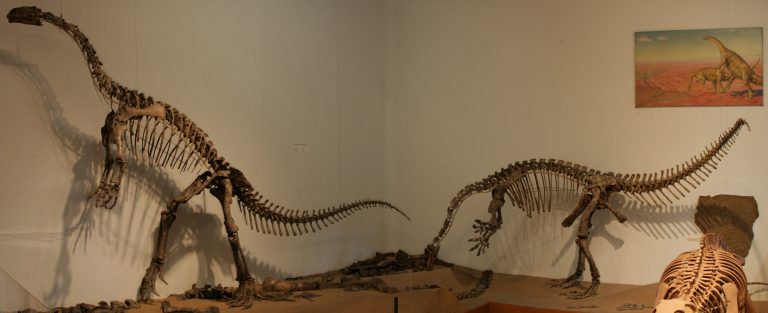
One of the first large herbivorous dinosaurs, this bipedal prosauropod browsed tree ferns across Late Triassic Europe before the rise of giant sauropods.
Related Paleontological Dispatches
Dinosaur News This Month: What Paleontologists Just Announced
Welcome to the October 2026 edition of Paleontological Dispatches, your curated, scientifically verified monthly roundup of what researchers…
The 10 Biggest Dinosaur Discoveries of the Last 5 Years
The last five years (2021–2026) represent one of the most prolific and intellectually transformative golden ages in the…

Why It Can Take 20 Years to Name a New Dinosaur
Whenever headlines announce that paleontologists have unveiled a spectacular new dinosaur species, the public naturally envisions a researcher…