LEARN ABOUT DINOSAURS•The Science Behind the Prehistoric World
Go beyond the fossils.
How do scientists reconstruct an extinct animal from a fragmentary jaw? How do we calculate a sauropod's weight, decode ancient diets from tooth enamel, or trace the evolutionary link between velociraptors and modern birds? Explore the rigorous evidence, laboratory technologies, taphonomic processes, and field discoveries that bring the Age of Dinosaurs into focus.
Field PaleontologyExcavating stratified bedding planes • Hell Creek Formation
From Bedrock to Discovery
Every published fact in this encyclopedia began as mineralized bone locked within geological strata. Field extraction requires delicate micro-tools, plaster jackets, and stratigraphic mapping.
FOUNDATION PILLARS
Start Here: Core Principles
Four essential questions that frame how scientists think about prehistoric life before examining single fossils.
What Is a Dinosaur?
Not all prehistoric reptiles were dinosaurs. Dinosaurs are specifically defined archosaurs with an upright, erect limb posture, pillar-like legs set directly beneath the body, an open hip socket (perforate acetabulum), and an in-turned femoral head. Pterosaurs and marine reptiles belong to different reptile branches.
Cladistic Definition
What Is Paleontology?
Paleontology is the rigorous, interdisciplinary study of ancient life. It sits at the intersection of geology (which dates rock strata), evolutionary biology (which traces phylogenetics), and chemistry (which decodes ancient isotopes in enamel and bone marrow).
Interdisciplinary Science
What Is a Fossil?
A fossil is any mineralized evidence of past life preserved in the geological record. Body fossils preserve physical structures like bones and teeth, while trace fossils preserve behavior: trackways, nests, coprolites, and bite marks. Most organisms decompose completely; fossilization is an extraordinary exception.
Taphonomic Record
How Do We Know?
We cannot observe living non-avian dinosaurs directly. Paleontological knowledge is built on testable anatomical hypotheses, comparative anatomy with living birds and crocodilians, engineering simulations (Finite Element Analysis), and geochemical testing of fossil rock matrices.
Empirical Method
FEATURED CURRICULUM
Key Scientific Investigations
Four in-depth visual guides exploring the most critical questions in paleobiology, illustrated with peer-reviewed scientific reconstructions.
How Fossils Form: The Chemical Journey from Bone to Stone
Fossils are far more than ancient bones. Discover how rapid burial, anoxic sediments, and groundwater mineral exchange turn organic remains into enduring stone over millions of years.
How Scientists Study Dinosaurs: Modern Analytical Methods
Paleontology has transformed from a field of picks and shovels into an interdisciplinary high-tech laboratory science using industrial CT scanners, growth histology, and Finite Element computer modeling.
6 min read
Evidence specimen: Archaeopteryx Lithographica
Are Birds Dinosaurs? The Evidence for Living Avian Dinosaurs
Every pigeon in the city square is a living theropod dinosaur. Explore the fossil, anatomical, and genetic evidence proving that birds did not merely descend from dinosaurs—they ARE dinosaurs.
8 min read
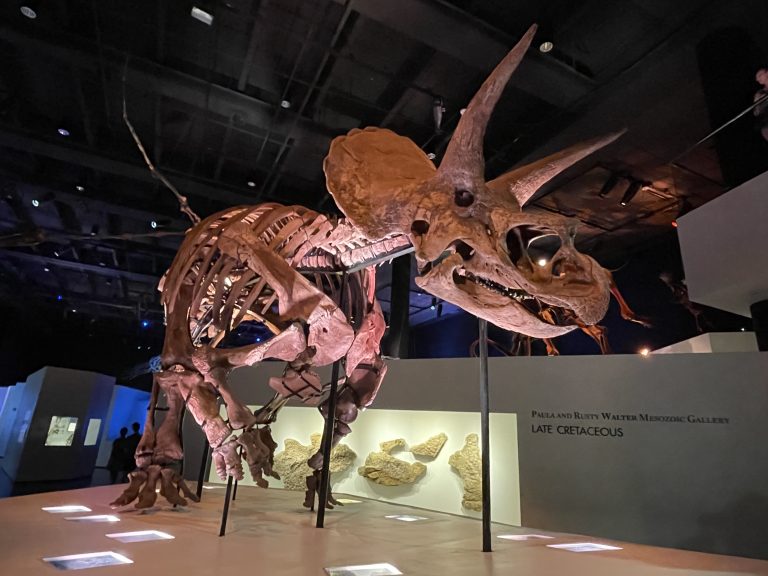
Evidence specimen: Triceratops Horridus
Why Did Non-Avian Dinosaurs Go Extinct? The 66-Million-Year Evidence
The Cretaceous-Paleogene boundary preserves one of Earth's most catastrophic events. Examine the geochemical iridium layer, shocked quartz, impact winter, and why birds and mammals survived while giants died.
KNOWLEDGE ARCHIVE
Educational Guides & Scientific Explanations
Filter by scientific discipline or search keywords to explore methodologies, anatomy, evolution, and field techniques.
Showing all 10 guides
Scientific Geological Reconstruction
Fossils & Evidence
6 min read
How Fossils Form: The Chemical Journey from Bone to Stone
Fossils are far more than ancient bones. Discover how rapid burial, anoxic sediments, and groundwater mineral exchange turn organic remains into enduring stone over millions of years.
Scientific Anatomical Reconstruction
Dinosaur Science
7 min read
How Scientists Study Dinosaurs: Modern Analytical Methods
Paleontology has transformed from a field of picks and shovels into an interdisciplinary high-tech laboratory science using industrial CT scanners, growth histology, and Finite Element computer modeling.
Linked Taxon:
Tyrannosaurus Rex
Scientific Avialan Reconstruction
Evolution & Relationships
6 min read
Are Birds Dinosaurs? The Evidence for Living Avian Dinosaurs
Every pigeon in the city square is a living theropod dinosaur. Explore the fossil, anatomical, and genetic evidence proving that birds did not merely descend from dinosaurs—they ARE dinosaurs.
Why Did Non-Avian Dinosaurs Go Extinct? The 66-Million-Year Evidence
The Cretaceous-Paleogene boundary preserves one of Earth's most catastrophic events. Examine the geochemical iridium layer, shocked quartz, impact winter, and why birds and mammals survived while giants died.
What Dinosaur Teeth and Jaws Tell Us About Prehistoric Diets
Teeth are the most durable tools an animal produces. Learn how enamel serrations, wear facets under electron microscopes, and jaw mechanics reveal exactly what extinct dinosaurs consumed.
How Scientists Estimate Dinosaur Size, Weight, and Speed
How do we know a sauropod weighed 60 metric tonnes without a scale? Explore the mathematical equations of allometric scaling, 3D laser volumetric modeling, and trackway speed physics.
How Scientists Build Dinosaur Family Trees: Understanding Cladistics
Superficial appearances are deceiving in paleontology. Discover how shared derived anatomical characters (synapomorphies) and phylogenetic cladistics map the evolutionary branches of Dinosauria.
From Quarry to Museum: How Fossils Are Excavated and Prepared
Discover the meticulous journey of a dinosaur fossil: from prospecting remote badlands outcrops and carving plaster field jackets to micro-air scribing inside the museum preparation laboratory.
Anatomy & Adaptation
6 min read
Feathers, Scales, and Skin: Fossil Evidence for Dinosaur Integument
Were dinosaurs scaly, feathery, or both? Examine the fossil evidence for integumentary structures across Dinosauria, from hadrosaur skin mummies to dromaeosaur quill knobs.
Life in the Mesozoic: Ancient Climates and Prehistoric Food Webs
Reconstruct the prehistoric biosphere beyond the dinosaurs: an equable greenhouse planet with no polar ice caps, towering gymnosperm forests, and the revolutionary rise of flowering plants.
No matching learning guides found
Try clearing your search keywords or switching to "All Topics" to browse the full curriculum.
SINGLE SOURCE OF TRUTH
Examine the Evidence in Our Collection
Every educational concept above is anchored in verified fossil specimens. Click any species to explore its comprehensive catalog dossier, physical dimensions, and museum photography.
Concise, evidence-based answers to common questions about fossils, evolutionary history, and scientific discovery.
What is paleontology, and how does it differ from archaeology?
Paleontology is the scientific study of ancient life through fossilized remains and impressions spanning billions of years of Earth history. In contrast, archaeology specifically investigates ancient human material culture, artifacts, and civilizations, generally covering only the last few million years. Paleontologists study fossils; archaeologists study human artifacts.
How do scientists know what dinosaurs looked like when only bones remain?
Paleontologists combine multiple lines of physical evidence: (1) comparative osteology with living archosaurs (birds and crocodilians), (2) muscle scar ridges on fossilized bones indicating muscle size and attachment points, (3) rare fossilized skin impressions and mummified carcasses revealing scale textures and skin patterns, (4) fossil melanosomes examined under electron microscopes revealing pigment types, and (5) computer biomechanical simulations testing joint articulation and weight distribution.
How are dinosaur fossils dated, and how old are they?
Dinosaur fossils range from roughly 233 million to 66 million years old. They cannot typically be dated directly using radiocarbon dating (which only works back ~50,000 years). Instead, geologists use radiometric dating—such as potassium-argon, argon-argon, and uranium-lead isotope decay—to date volcanic ash layers (bentonite/tephra) and igneous rock beds sandwiched above and below the sedimentary fossil-bearing strata, establishing precise radiometric brackets.
What is the difference between a body fossil and a trace fossil?
A body fossil preserves actual physical parts of the organism itself—such as mineralized bones, teeth, claws, shells, or petrified wood. A trace fossil (ichnite) preserves evidence of the organism's activity or behavior during life—including footprints, trackways, burrows, nests, fossilized eggs, bite marks, and fossilized feces (coprolites).
Why do dinosaur size and weight estimates change over time?
Size estimates are continually refined as new, more complete skeletons are unearthed and analytical techniques advance. Mass estimates in paleontology rely on two primary methods: volumetric 3D reconstruction (calculating the volume of a digital fleshed-out skeleton and multiplying by animal density) and bivariate limb-bone scaling (measuring the circumference of load-bearing leg bones). When new specimens reveal longer tails, wider torsos, or extensive internal air sacs (pneumaticity), weight estimates are mathematically updated.
How do paleontologists determine what a dinosaur ate?
Diet is deduced through five independent evidentiary avenues: (1) tooth shape and serration patterns (sharp ziphodont blades for carnivores vs. grinding dental batteries or raking peg teeth for herbivores), (2) jaw biomechanics and bite force modeling, (3) microscopic wear scratches and pits (dental microwear) caused by plant grit or bone crunching, (4) rare direct cololites (fossilized gut contents found inside the ribcage), and (5) chemically analyzed coprolites (fossilized droppings).
Are modern birds really living dinosaurs?
Yes. Phylogenetically, birds (Aves / Neornithes) are avian theropod dinosaurs. Birds share over one hundred distinct anatomical characteristics with non-avian maniraptoran theropods, including wishbones (furculae), hollow air-filled bones, bipedal digitigrade stance, three-toed feet, complex pennaceous feathers, and brooding behavior over clutches of eggs. Modern cladistics classifies birds as the only surviving lineage of Dinosauria.
Why did non-avian dinosaurs go extinct while mammals and birds survived?
The end-Cretaceous (K-Pg) extinction 66 million years ago was triggered by a 10-kilometer asteroid impact at Chicxulub, Mexico, compounded by massive Deccan Traps volcanism. The resulting dust and soot halted photosynthesis, causing primary food chains to collapse. Large non-avian dinosaurs required immense amounts of daily forage or large prey and could not burrow or hibernate. Small generalists—including early mammals, small ground-dwelling birds with seed-eating beaks, lizards, and aquatic organisms feeding on detritus—were able to shelter underground or in freshwater ecosystems until conditions stabilized.
CONTINUE EXPLORING
Explore the Living Museum
Apply your scientific understanding across our interactive timeline, comparison engine, species directory, and field dispatches.