Why It Can Take 20 Years to Name a New Dinosaur
When news breaks of a 'newly discovered' dinosaur, the fossil was rarely dug up this year. Between multi-ton plaster backlogs, thousands of hours of pneumatic lab preparation, micro-CT scanning, and peer-review debates, naming a species is a marathon of scientific patience.

Whenever headlines announce that paleontologists have unveiled a spectacular new dinosaur species, the public naturally envisions a researcher swinging a rock pick in the desert and walking into a press conference a few weeks later. Yet when you examine the fine print of the scientific monograph, a startling truth emerges: the fossil was often quarried twenty, thirty, or even fifty years ago.
Consider Ptychotherates bucculentus, formally named in 2026—its holotype skull was extracted from New Mexico in 1982, forty-four years earlier. Or the bizarre, hump-backed giant Deinocheirus mirificus, whose enigmatic eight-foot arms were collected in the Mongolian Gobi Desert in 1965, but whose complete skeleton and skull were not fully solved and published in Nature until 2014—nearly half a century later.
Why does it take so long to name a new dinosaur? Is it academic bureaucracy, lack of interest, or scientific inertia? The answer lies in the harsh physical, technological, and economic realities of vertebrate paleontology. Naming a dinosaur is not a sprint; it is an epic marathon governed by the multi-stage pipeline: discovered → excavated → prepared → analyzed → described → published.
The Anatomy of a 20-Year Delay: Major Bottlenecks
- 1. The Preparation Backlog: Up to 5,000 lab hours per specimen
- 2. Plaster Jacket Storage: Decades spent unopened in museum basements
- 3. Missing Skeletal Pieces: Waiting for subsequent field seasons
- 4. Advanced Diagnostics: Synchrotron & micro-CT scanner scheduling
- 5. Comparative Global Audits: Visiting collections on multiple continents
- 6. Funding & Career Reality: The economic constraints of non-commercial science
1. The Plaster Jacket Backlog: Museums’ Hidden Treasures
When field crews discover a substantial dinosaur skeleton in remote badlands, field time is strictly limited by weather, permits, and summer funding windows. Rather than freeing every individual bone on the hillside, crews dig trenches around the entire bonebed, encase the rock in burlap soaked in dental plaster, and haul multi-ton “jackets” back to the museum.
The result is a worldwide logistical phenomenon known as the museum backlog. Institutions like the American Museum of Natural History in New York, the Field Museum in Chicago, and the Carnegie Museum in Pittsburgh house thousands of unopened plaster jackets in climate-controlled basements. Some jackets collected during the Great Depression or the 1970s have sat undisturbed for decades simply because field expeditions bring fossils in far faster than laboratory preparators can clean them.
2. The Agony of the Air Scribe: Thousands of Hours of Manual Labor
Fossil bone embedded in dense ironstone, quartzite, or volcaniclastic sandstone does not pop out cleanly. It is chemically welded to the surrounding rock matrix. Freeing fragile, fractured fossilized bone requires specialized technicians known as fossil preparators.
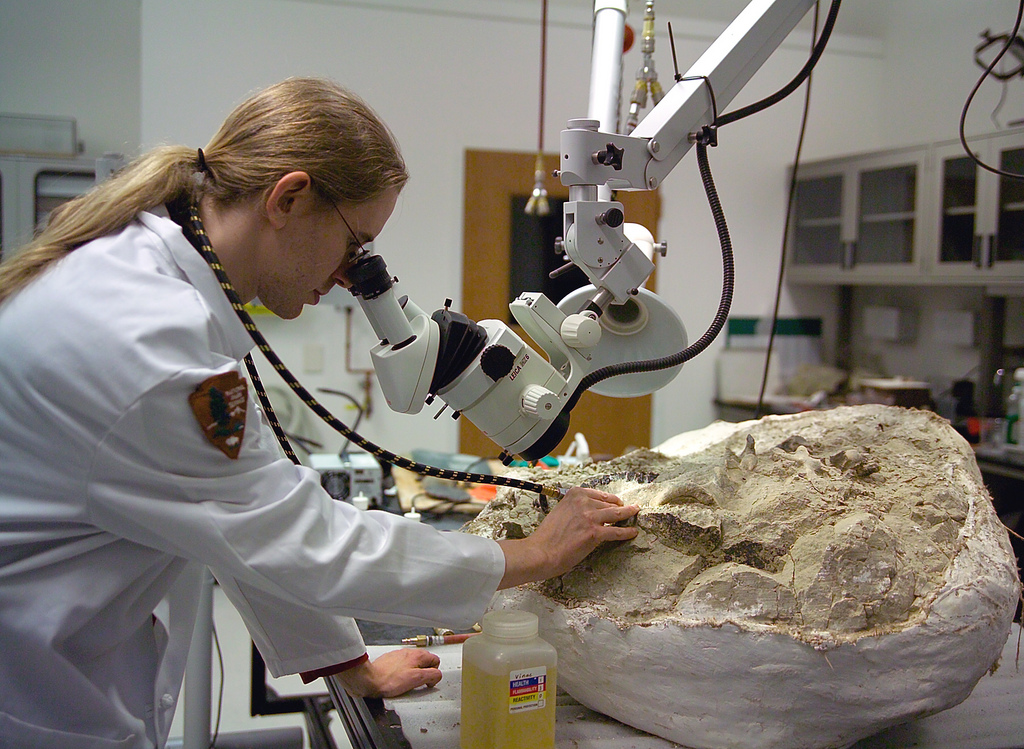
Armed with pneumatic air scribes—delicate vibrating tungsten needles driven by compressed air—preparators must work under high-powered binocular microscopes, chipping away sand grains one millimeter at a time. A typical dinosaur skull or vertebral column requires between 1,000 and 5,000 hours of skilled laboratory preparation. At 40 hours a week, a single technician working full-time can spend three to four continuous years preparing just one medium-sized skeleton. Because major museums often employ only two or three preparators to service hundreds of active researchers, a newly discovered fossil must wait in line for years before preparation even begins.
3. Comparative Anatomy: The Search for Missing Diagnostic Traits
Once the bone is prepared, a researcher cannot simply write a paper claiming it is new. Under the rules of the International Commission on Zoological Nomenclature (ICZN), an author must provide a rigorous differential diagnosis based on unique derived anatomical features (autapomorphies).
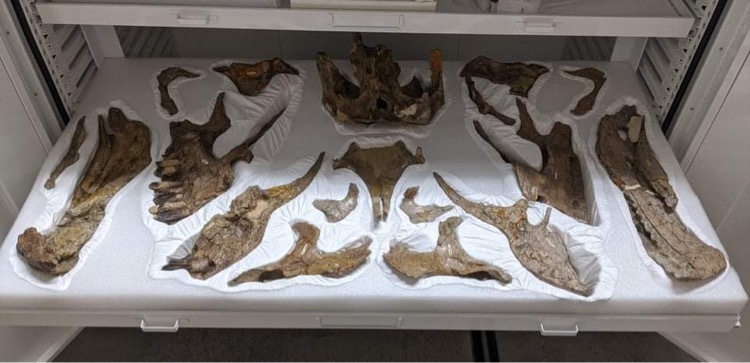
To verify that an unusual bump on a pelvic bone or lower jaw is truly a unique species marker—rather than a broken bone that healed awkwardly (pathology), an animal of an unusual age (ontogeny), or natural individual variation within an existing species—paleontologists must compare the specimen with every related fossil on Earth. This requires travel grants to examine holotype drawers in London, Paris, Beijing, Cape Town, and Buenos Aires. Securing competitive travel grants and permissions to access high-security museum collections can consume several years of an academic’s career.
4. Missing Pieces: When One Bone Isn’t Enough
A frequent reason for multi-decade delays is that the initial discovery was tantalizingly incomplete. If a field team finds only an isolated femur or a broken tooth, responsible paleontologists generally refrain from naming a new species, as naming a taxon based on undiagnostic scraps creates a scientifically useless nomen dubium (“doubtful name”).
Instead, researchers keep the quarry site confidential and return year after year, hoping erosion or new trenches uncover the skull, pelvis, or associated limbs required to establish a valid diagnosis. In the case of South Africa’s colossal sauropodomorph Ledumahadi mafube, partial remains found in the early 1990s were intentionally held until extensive supplementary excavations decades later finally recovered the complete limb and vertebral columns necessary to prove its revolutionary quadrupedal posture.
5. The High-Tech Diagnostic Revolution: CT Scans and Synchrotrons
In the 19th and 20th centuries, naming a dinosaur primarily required visual descriptions and lithographic pencil drawings. Today, high-impact journals expect comprehensive digital osteology. Researchers must subject type specimens to:
- Industrial Micro-CT Scanning: Revealing internal braincases, neurovascular cranial channels, and unerupted replacement teeth trapped inside solid bone.
- Synchrotron Radiation Imaging: Utilizing particle accelerators to image soft tissue impressions and growth lines without touching the rock.
- Bone Histology: Cutting microscopic thin sections of limb bones to count lines of arrested growth (LAGs), proving whether the fossil represents an adult of a small species or a juvenile of a giant.
Access to industrial CT scanners capable of penetrating dense dinosaur bone is extremely limited. Paleontologists must submit competitive beamtime proposals at national particle physics laboratories or negotiate scanning time at regional medical facilities, adding months or years to research schedules.
6. Case Studies: Famous Multi-Decade Dinosaur Timelines
The table below highlights real, verified examples of famous dinosaurs that required decades between discovery and formal scientific naming:
| Dinosaur Taxon | Year Discovered | Year Named | Timeline Lag | Primary Reason for the Delay |
|---|---|---|---|---|
| Deinocheirus mirificus | 1965 (Gobi Desert) | 2014 (Full monograph) | 49 Years | Arms named in 1970; body and skull looted by poachers, recovered in Europe, and matched to quarry 44 years later. |
| Ptychotherates bucculentus | 1982 (Ghost Ranch) | 2026 | 44 Years | Fossil skull remained encased in a dense multi-specimen block awaiting micro-preparation and modern CT imaging. |
| Ledumahadi mafube | 1990 (South Africa) | 2018 | 28 Years | Extended excavations over two decades required to extract sufficient associated limb elements for diagnostic certainty. |
| Brontomerus mcintoshi | 1994 (Grand County, UT) | 2011 | 17 Years | Specimens severely broken by commercial looters; required years of puzzle-like piecing and histology before naming. |
| Dreadnoughtus schrani | 2005 (Patagonia) | 2014 | 9 Years | Colossal physical scale: 16 tons of plaster jackets required years of preparation and complete 3D laser surface digitization. |
7. The Economic Reality: Pure Science on a Shoestring Budget
A crucial factor the public often overlooks is that vertebrate paleontology is a fundamental, non-commercial science. Unlike pharmaceutical research or aerospace engineering, paleontology does not generate patent revenues or venture capital funding.
Most dinosaur research is conducted by university professors, postdoctoral researchers, and museum curators who juggle teaching heavy course loads, managing collections, and mentoring students. Securing a $50,000 research grant from agencies like the National Science Foundation (NSF) or National Geographic can take multiple grant application cycles. When funding dries up, projects must be put on hold while researchers pivot to funded teaching or administrative responsibilities.
8. Peer Review Debates and Competing Interpretations
Once a comprehensive monograph is finally written, it must face the gauntlet of academic peer review. In paleontology, taxonomic disputes can be fiercely contentious. If reviewers believe the proposed new dinosaur is actually an immature specimen of an already-known animal, or if they dispute the phylogenetic character matrix, the paper can undergo years of back-and-forth revision, re-measurement, and statistical re-testing before the journal editor grants final acceptance.
Common Mistakes and Misconceptions About Discovery Timelines
Misconception 1: “Every single dinosaur takes 20 years to name.”
Reality: Not every dinosaur takes decades. If an exceptionally complete, pristine skeleton of an obvious new group is discovered by a well-funded research team with dedicated lab staff, publication can occur in 3 to 5 years. Twenty-year timelines occur primarily when specimens are trapped in museum backlogs, require extensive matrix removal, or represent fragmentary discoveries that require supplemental field seasons.
Misconception 2: “Museums are hiding discoveries from the public.”
Reality: Stored fossils are not secrets; they are protected scientific specimens awaiting the necessary resources, expertise, and technology to be analyzed properly without destroying diagnostic bone structures.
Misconception 3: “A faster publication timeline is always better.”
Reality: Rushing a dinosaur name to press without thorough preparation and comparative study almost always leads to scientific failure. Hundreds of 19th-century dinosaur names rushed into print during the “Bone Wars” were subsequently invalidated as junior synonyms or unidentifiable nomina dubia.
Frequently Asked Questions
What is the single biggest bottleneck in naming a new dinosaur?
Mechanical laboratory preparation. Freeing delicate, fractured bones from dense rock matrix with miniature air scribes under a microscope requires thousands of technician hours per skeleton, and there are far fewer skilled preparators than fossil jackets in museum collections.
Can new species be discovered sitting inside a museum drawer?
Yes. A substantial percentage of new dinosaur species named each year are discovered inside museum collections rather than in the field. Re-examining historical fossils using modern micro-CT scans, paleohistology, or refined phylogenetic methods frequently reveals unrecognized taxa.
Why don’t museums just hire more technicians to speed things up?
Funding constraints. Natural history museums operate as non-profit educational institutions relying on government grants, university endowments, and donations. Highly skilled fossil preparation requires specialized salaries and climate-controlled laboratory equipment that budgets cannot always expand.
How does CT scanning save time in naming dinosaurs?
CT scanning allows researchers to peer inside intact rock jackets or un-prepared skulls, viewing internal braincases and tooth structures in 3D without spending years manually picking away rock, accelerating preliminary diagnoses and guiding mechanical preparation.
What happens if someone names a dinosaur based on poor preparation?
The name is often rejected or declared a nomen dubium (doubtful name) by the scientific community. If later researchers cannot verify the diagnostic traits because the fossil was damaged during hasty preparation, the species cannot be confirmed.
Final Takeaway: The True Virtue of Scientific Rigor
The multi-decade timeline between finding a dinosaur and publishing its scientific name is not a failure of paleontology; it is its greatest strength. It represents the meticulous devotion of technicians who spend years picking away rock grain by grain, the patience of researchers who travel the world to verify subtle anatomical details, and the integrity of a scientific process that refuses to cut corners for a quick headline.
When you read about a newly named dinosaur today, remember that you are celebrating not just a recent breakthrough, but decades of dedicated stewardship, technological innovation, and painstaking scientific detective work.
To explore more about the history and science of dinosaur discovery, dive into our Dinosaur Encyclopedia, trace historical milestones on our Geological Timeline, or explore our curated field reports on Paleontological Dispatches.
Key References & Historical Studies
- Lee, Y. N., Barsbold, R., Currie, P. J., Kobayashi, Y., Lee, H. J., Godefroit, P., Escuillié, F., & Tsogtbaatar, K. (2014). Resolving the long-standing enigmas of a giant ornithomimosaur Deinocheirus mirificus. Nature, 515(7526): 257–260. DOI: 10.1038/nature13874
- Srivastava, S., & Nesbitt, S. J. (2026). A short-snouted, deep-cheeked herrerasaurian dinosaur from the Late Triassic of North America and the longevity of early dinosaur lineages. Zoological Journal of the Linnean Society, zlae038. DOI: 10.1093/zoolinnean/zlae038
- McPhee, B. W., et al. (2018). A giant dinosaur from the earliest Jurassic of South Africa and the transition to quadrupedality in early sauropodomorphs. Current Biology, 28(19): 3143–3151. DOI: 10.1016/j.cub.2018.07.063
- Taylor, M. P. (2011). Brontomerus mcintoshi: A new sauropod dinosaur from the Lower Cretaceous Cedar Mountain Formation, Utah, USA. Acta Palaeontologica Polonica, 56(1): 75–98. DOI: 10.4202/app.2010.0073
- Lacovara, K. J., et al. (2014). A gigantic, exceptionally complete titanosaurian sauropod dinosaur from southern Patagonia, Argentina. Scientific Reports, 4: 6196. DOI: 10.1038/srep06196

Referenced Dinosaur Species 5 species
Tyrannosaurus rex
Tyrannosaurus rex
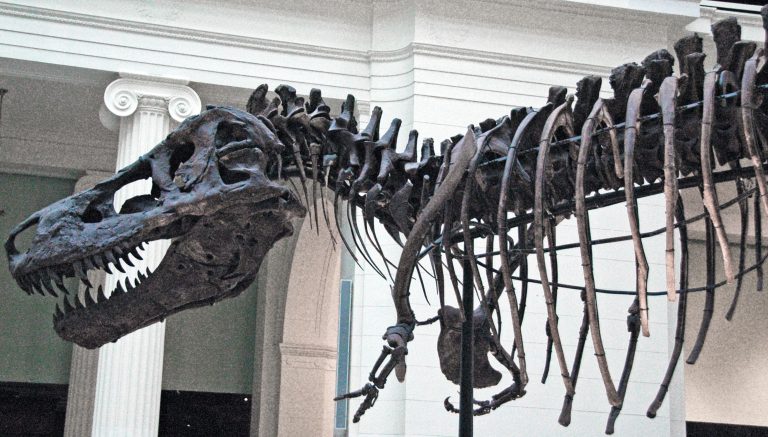
Tyrannosaurus rex was one of the largest terrestrial carnivores of all time, roaming western North America just prior to the Cretaceous-Paleogene extinction event. With an estimated bite force exceeding 35,000 Newtons and acute stereoscopic vision, it sat uncontested at the apex of its ecosystem.
Brachiosaurus altithorax
Brachiosaurus altithorax
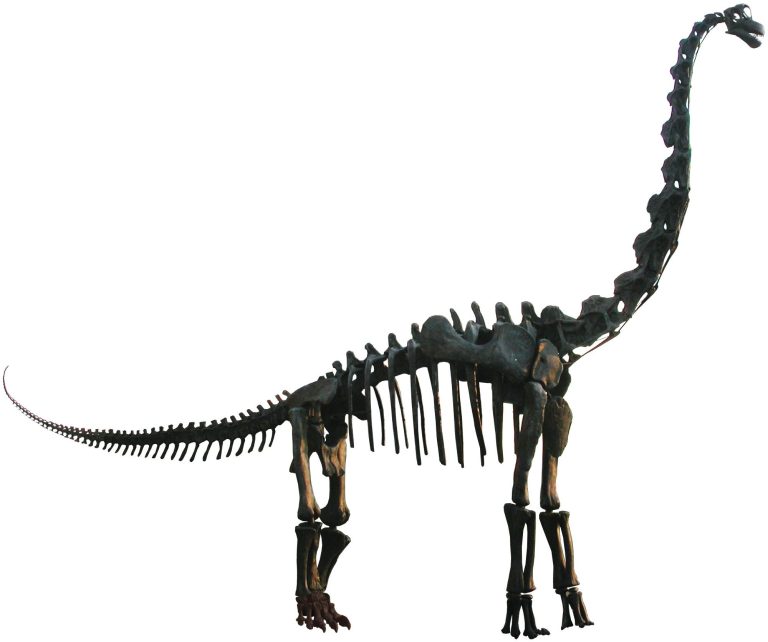
A colossal macronarian sauropod with disproportionately long forelimbs and an elevated neck built for high-canopy conifer browsing during the Late Jurassic.
Coelophysis bauri
Coelophysis bauri
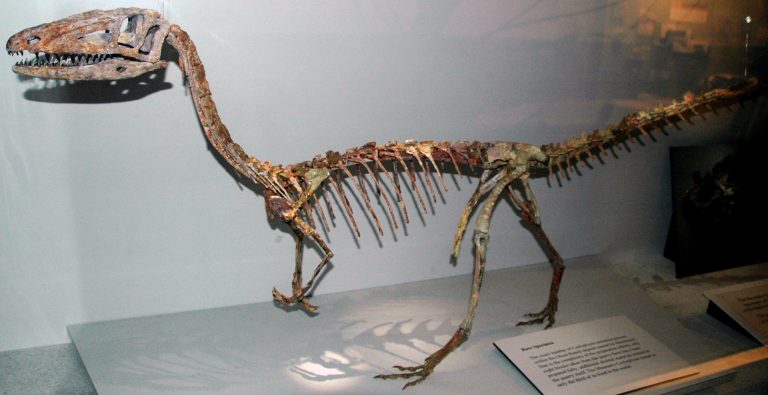
A gracile, agile early theropod that flourished across Late Triassic floodplains, hunting small vertebrates and insects with slender grasping jaws and lightweight hollow bones.
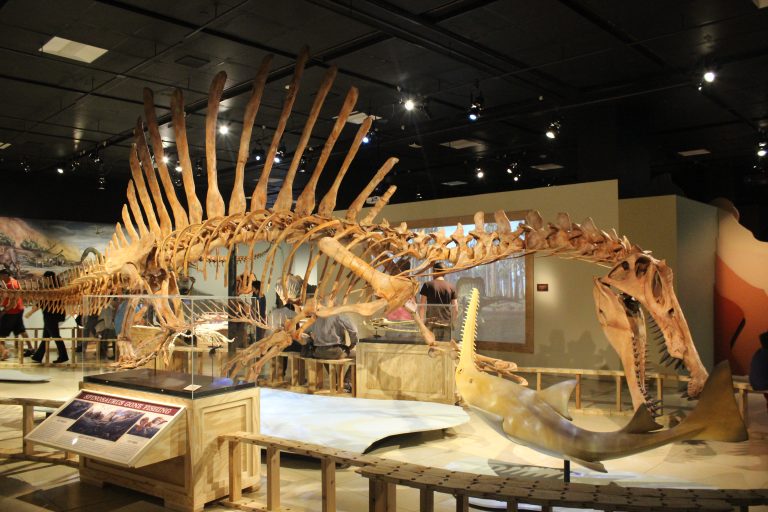
Spinosaurus aegyptiacus
Spinosaurus aegyptiacus
A colossal semi-aquatic predatory theropod equipped with a massive dorsal neural sail, crocodyliform snout, and paddle-like tail adapted for pursuing giant Cretaceous fish.
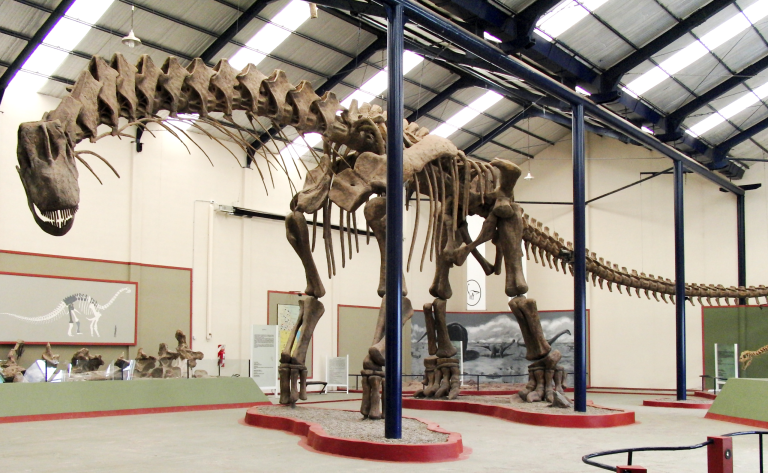
Argentinosaurus huinculensis
Argentinosaurus huinculensis
One of the largest land animals in Earth history, this colossal titanosaur shook the Cretaceous plains of South America with dorsal vertebrae measuring over 1.5 meters high.
Related Paleontological Dispatches
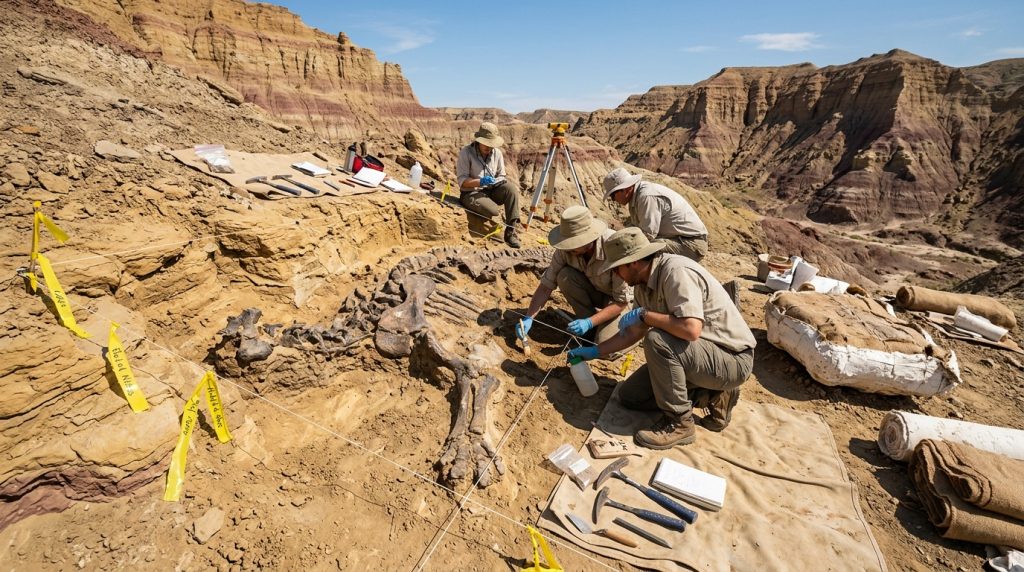
Dinosaur News This Month: What Paleontologists Just Announced
Welcome to the October 2026 edition of Paleontological Dispatches, your curated, scientifically verified monthly roundup of what researchers…
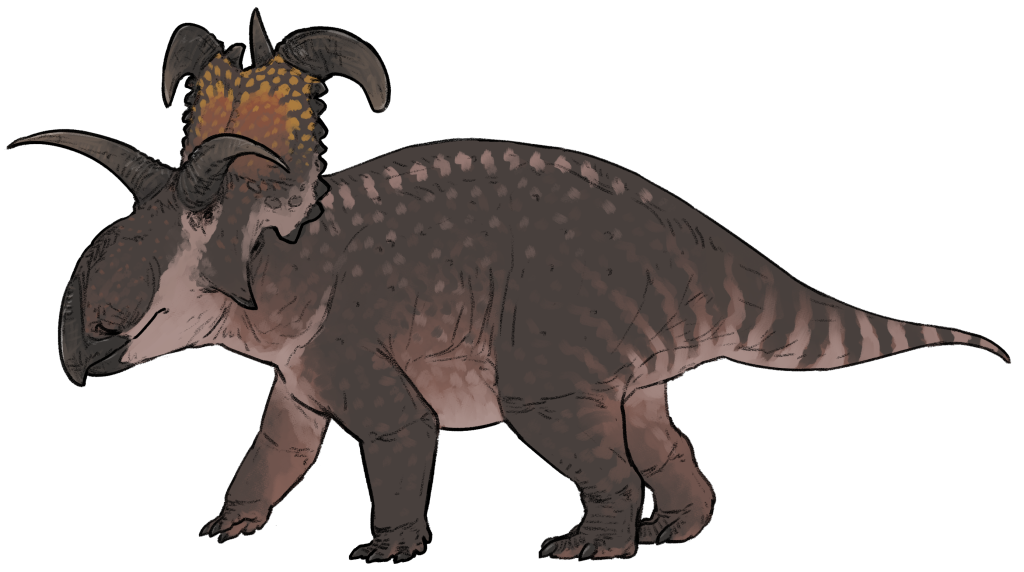
The 10 Biggest Dinosaur Discoveries of the Last 5 Years
The last five years (2021–2026) represent one of the most prolific and intellectually transformative golden ages in the…
How Scientists Name a New Dinosaur Species, Step by Step
In popular culture, discovering and naming a dinosaur is often imagined as a sudden, poetic epiphany: a paleontologist…