Doolysaurus: The Baby Dinosaur That Broke South Korea’s 15-Year Fossil Gap
In March 2026, paleontologists revealed Doolysaurus huhmini from Aphae Island—the first skeletal dinosaur named from South Korea in 15 years, and the very first to preserve its skull.
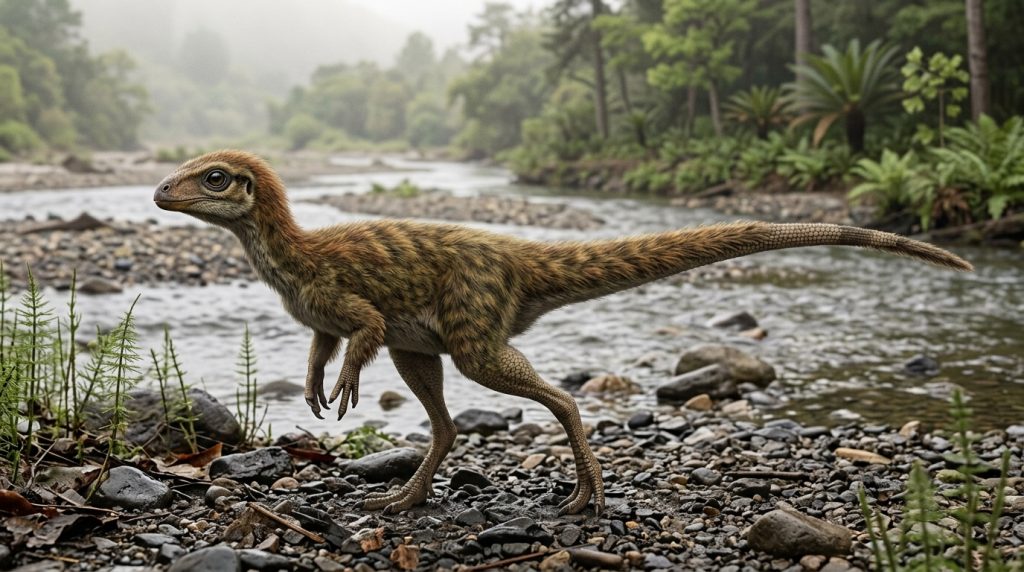
When paleontologists announced a newly described dinosaur named after South Korea’s most beloved cartoon character in March 2026, international headlines celebrated the arrival of Doolysaurus—a turkey-sized “baby dinosaur” hailed as breaking a mysterious 15-year fossil drought. But beneath the charming pop-culture homage lies a profound scientific milestone: specimen KDRC-SA-V001 is not merely a novelty namesake, but the very first dinosaur skeleton in South Korean history to preserve diagnostic elements of its skull, solving key puzzles about how early-diverging ornithischian dinosaurs lived, grew, and fed across Cretaceous East Asia.
?? Specimen At-A-Glance: Doolysaurus huhmini
1. What Is Doolysaurus? From Pop-Culture Icon to Paleontological Landmark
To understand the public enthusiasm greeting this discovery, one must appreciate the cultural footprint of its namesake. In 1983, South Korean cartoonist Kim Soo-jung introduced comic readers to Dooly the Little Dinosaur (???? ??, Agigongnyong Duli). In the beloved animated series, Dooly is an orphaned, mischievous green baby dinosaur trapped in an Arctic glacier for millions of years before thawing out in the modern Han River in central Seoul. For generations of South Koreans, Dooly served as their very first introduction to prehistoric life.
Four decades later, an international team of paleontologists led by Dr. Jongyun Jung (Seoul National University / University of Texas at Austin), alongside Minguk Kim, Hyemin Jo, and Dr. Julia A. Clarke, immortalized that cultural heritage in the scientific record. Publishing in the peer-reviewed journal Fossil Record on March 19, 2026, the authors formally established Doolysaurus huhmini as a valid new genus and species of thescelosaurid ornithischian dinosaur.
The specific epithet, huhmini, pays tribute to Professor Dr. Min Huh of Chonnam National University, director of the Korea Dinosaur Research Center (KDRC). Professor Huh dedicated over thirty years to cataloging and protecting South Korea’s rich fossil heritage, leading the landmark excavation of Koreanosaurus boseongensis in 2003 and pioneering the conservation of Korea’s monumental dinosaur nesting grounds. By uniting a beloved national cartoon character with the father of modern Korean dinosaur paleontology, the new taxon bridges cultural affection and world-class evolutionary science.
2. Demystifying the “15-Year Fossil Gap”: Tracks Versus Skeletons in Korea
Many early news reports reported that South Korea had gone “15 years without discovering any dinosaurs.” To an outside observer, that statement sounds astonishing: South Korea is universally acknowledged by paleontologists as one of the richest Cretaceous ichnological capitals on Earth. How could there be a 15-year gap?
The answer hinges on a crucial distinction in paleontology: trace fossils (ichnofossils) versus body fossils (skeletal remains).
Across the Gyeongsang Basin, Haenam, Hwasun, and the southern coastline, Korean geological strata preserve tens of thousands of exquisite dinosaur footprints, sprawling sauropod trackways, pterosaur tracks, bird footprints, and massive clutches of fossilized dinosaur eggs. Paleontologists in South Korea discover new tracks and nesting sites almost every year.
However, articulated skeletons and body fossils are extraordinarily rare in South Korea. During the Cretaceous Period, the Korean Peninsula was dominated by active volcanic arcs, high-energy braided rivers, and seasonal lake systems. Acidic volcanic soils and turbulent alluvial deposition frequently dissolved or obliterated delicate animal bones before they could undergo permineralization. Consequently, finding an actual dinosaur skeleton in Korean bedrock is an event of supreme rarity.
| Dinosaur Taxon | Year Named | Locality & Material | Cranial Material Preserved? |
|---|---|---|---|
| “Ultrasaurus” tabriensis | 1983 | Gyeongsang Basin (Partial ulna / doubtful) | No (Nomen dubium) |
| Koreanosaurus boseongensis | 2011 (described 2010/11) | Boseong County (Postcranial limbs, shoulder girdle) | No (Postcrania only) |
| Koreaceratops hwaseongensis | 2011 | Hwaseong City (Partial pelvis, hindlimbs, paddle-tail) | No (Postcrania only) |
| Doolysaurus huhmini | 2026 | Aphae Island (Partial skeleton, gastroliths, skull elements) | YES (First in Korean History) |
Prior to 2026, the last valid skeletal dinosaurs named from South Korea were Koreanosaurus boseongensis and Koreaceratops hwaseongensis, both published in 2011. Exactly 15 years elapsed between those 2011 descriptions and the formal publication of Doolysaurus in March 2026. Thus, the “15-year fossil gap” refers strictly to the formal naming of articulated dinosaur body fossils—and Doolysaurus shattered that drought in spectacular fashion.
3. The 2023 Field Discovery on Aphae Island
The story of Doolysaurus began during field reconnaissance on Aphae Island (Aphaedo) in Sinan County, South Jeolla Province, situated off the southwestern coast of South Korea. Field researcher Hyemin Jo identified an unusual, densely packed block of volcaniclastic sandstone weathering out of an exposed coastal outcrop.
The rocks belong to the Ilseongsan Formation, a mid-Cretaceous geological package deposited during the Albian to Cenomanian stages (approximately 100 to 95 million years ago). During this slice of the Mesozoic, the region was an active inland tectonic basin characterized by seasonal rainfall, braided stream channels, and episodic volcanic ash falls. The fine-grained tuffaceous sandstones acted as an exceptional preservation trap, rapidly burying the carcass of a small animal before scavengers, river currents, or acidic groundwaters could scatter its bones.
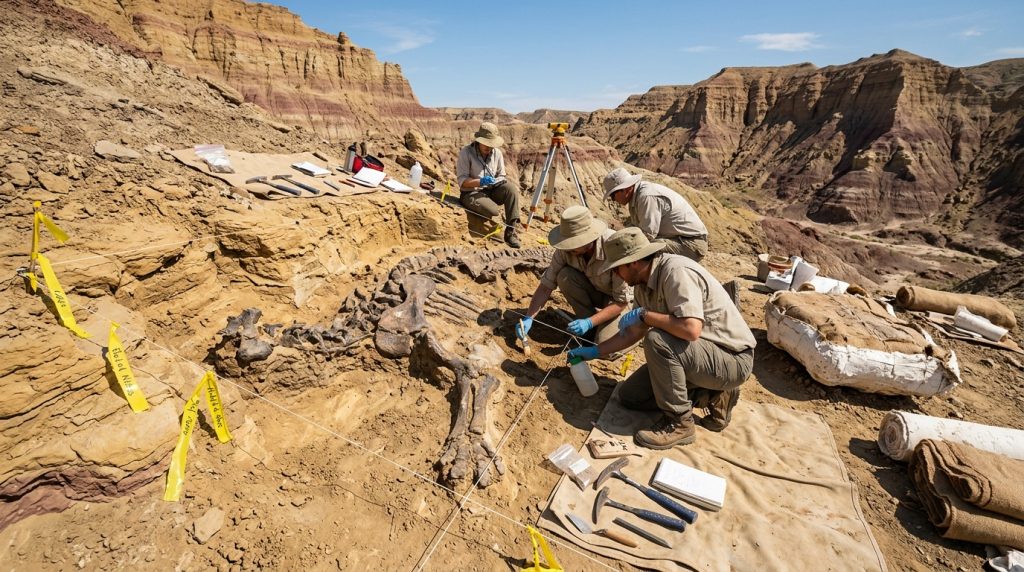
Because the bone was encased within extremely dense, hard silicified matrix, traditional mechanical preparation using air scribes risked shattering the brittle fossil material. The block was carefully jacketed and stabilized for advanced non-destructive laboratory investigation.
4. What the Bones Reveal: Micro-CT Scanning and the First Korean Dinosaur Skull

To inspect the specimen without destroying the surrounding rock, the research team transferred the specimen to the High-Resolution X-ray Computed Tomography Facility at the University of Texas at Austin. Utilizing micro-computed tomography (micro-CT), the team generated thousands of virtual X-ray cross-sections, allowing them to digitally segment and reconstruct the skeleton in 3D.
What the digital scans revealed was groundbreaking:
- Articulated Postcranial Skeleton: Multiple articulated dorsal and sacral vertebrae, complete ribs, pelvic elements (ilium and ischium), and substantial portions of the hindlimbs, including the femur, tibia, fibula, and pes (foot).
- Preserved Cranial Elements: Most critically, the scans identified portions of the cranium, including elements of the maxilla, dentary, and braincase, complete with in-situ teeth.
- Intact Gastroliths: A concentrated cluster of smooth, polished pebbles located precisely within the anatomical position of the animal’s digestive tract.
The presence of cranial elements represents a historic first for South Korean paleontology. Neither Koreanosaurus nor Koreaceratops possessed preserved skull bones; their descriptions were based solely on limb girdles and vertebral columns. Doolysaurus provides the first direct window into the cranial anatomy, sensory structures, and jaw mechanics of a Korean dinosaur.
5. Why Scientists Call It a “Baby”: Bone Histology and Ontogeny
Popular media headlines frequently dubbed Doolysaurus a “baby dinosaur.” In colloquial language, “baby” implies a newly hatched neonate fresh from an eggshell. In vertebrate paleontology, however, growth stages are determined through osteohistology—the microscopic examination of bone tissue architecture.
The team extracted a micro-core from the midshaft of the femur to examine its growth rings under polarized light microscopy. The histological thin section revealed:
- High Vascular Density: The cortical bone tissue consists of fibro-lamellar bone packed with dense, radiating vascular canals, indicative of rapid, uninterrupted somatic growth.
- Absence of an External Fundamental System (EFS): An EFS is a dense layer of closely spaced resting lines that forms at the outer bone surface once an animal reaches skeletal maturity and stops growing. Specimen KDRC-SA-V001 shows no outer resting zone whatsoever.
- Growth Mark Analysis: The specimen displays features consistent with an early juvenile stage, estimated between 0 and 2 years of age at the time of death.
In life, this individual measured roughly 80 to 100 centimeters (2.6 to 3.3 feet) from snout to tail tip, standing approximately 35 to 45 centimeters tall at the hip with an estimated body mass between 2.5 and 3.5 kilograms (5.5 to 7.7 lbs)—comparable in size to a modern wild turkey. By contrast, adult thescelosaurids typically grew to lengths between 2.5 and 4 meters (8 to 13 feet) and weighed between 50 and 150 kilograms. While not a newborn hatchling, Doolysaurus was unquestionably an actively developing young animal, offering precious insight into juvenile ornithischian ontogeny.
6. Gastroliths and Dentition: How Doolysaurus Fed
One of the most biologically revealing discoveries inside specimen KDRC-SA-V001 is a tightly localized cluster of gastroliths (gizzard stones) resting between the rib cage and the pelvic girdle. These stones are smooth, rounded pebbles composed of quartz and chert, distinctly polished and foreign to the fine-grained silty sediment that buried the skeleton.
Many modern birds and crocodilians intentionally ingest stones to grind tough fibrous food inside a muscular gastric mill. While gastroliths are well-documented in giant sauropods, horned ceratopsians, and certain theropods like ornithomimosaurs, discovering a pristine gastric mill in a small juvenile neornithischian is remarkably informative:
- Functional Dental Supplementation: Micro-CT imaging of the dentary and maxilla showed leaf-shaped, ridged phyllodont teeth. While effective at cropping and shearing herbaceous foliage, these teeth lacked the complex grinding batteries found in later duck-billed hadrosaurs. The gastric stones provided the mechanical processing power required to pulverize fibrous Cretaceous vegetation, horsetails, and seed ferns.
- Opportunistic Omnivory: The authors noted that the combination of small, serrated teeth, acute binocular vision, and gastric stones is consistent with an adaptable, opportunistic diet. Young thescelosaurids may have consumed high-energy plant shoots, seeds, fallen fruits, and occasional invertebrates or small vertebrates, utilizing their gizzard stones to digest hard seeds and chitinous exoskeletons.
- Early Ontogenetic Ingestion: The presence of gastroliths in a two-year-old juvenile indicates that stone-swallowing behavior was acquired very early in life, rather than being an adult-exclusive adaptation.
7. Where Doolysaurus Fits in the Dinosaur Family Tree
Phylogenetically, Doolysaurus huhmini belongs to the clade Thescelosauridae, an early-diverging branch of Neornithischia. These small-to-medium-sized bipedal herbivores were once lumped into the wastebasket taxon “Hypsilophodontidae,” but modern cladistic analyses recognize them as a distinct, highly successful evolutionary radiation spanning both Asia and North America.
Within East Asia, Doolysaurus shares phylogenetic affinities with other mid-Cretaceous basal ornithischians such as Jeholosaurus and Changchunsaurus from northeastern China, and its Korean relative Koreanosaurus boseongensis. However, comparative anatomical analysis highlights sharp evolutionary divergences between the two Korean taxa:
Comparative Ecomorphology: Doolysaurus vs. Koreanosaurus
While Koreanosaurus developed heavily reinforced shoulders, bowed humeri, and massive forelimbs adapted for scratch-digging and subterranean burrowing, Doolysaurus retained the classic ancestral cursorial body plan: elongated distal hindlimbs, a slender femur, and a stiffened counterbalancing tail built for rapid bipedal sprinting across open riverbanks to evade contemporary mid-Cretaceous theropod predators.
The discovery demonstrates that during the mid-Cretaceous, the Korean Peninsula supported an ecologically partitioned community of small ornithischians, with specialized burrowers (like Koreanosaurus) and agile cursorial browsers (like Doolysaurus) coexisting in the same regional river systems.
8. What Scientists Still Do Not Know
In responsible paleontology, documenting the boundaries of current knowledge is just as vital as celebrating new discoveries. With only a single juvenile specimen currently cataloged, several major biological questions remain open:
- Adult Morphology and Proportions: Because KDRC-SA-V001 represents a juvenile, researchers cannot yet be certain how cranial ornamentation, skull length, or body proportions changed as Doolysaurus matured into adulthood. Did adult individuals develop distinct facial bosses, or did they retain a gracile, unadorned skull?
- Missing Manus and Distal Tail: While the hindlimbs and pelvis are well represented, the delicate fingers of the hands (manus) and the distal terminus of the tail were not recovered in the initial block. Discovering further specimens will be required to confirm whether the forelimbs possessed four or five clawed digits.
- Integumentary Structure: While basal neornithischians from Russia (such as Kulindadromeus) and China (such as Tianyulong) preserve monofilamentous proto-feathers across their dorsum, the sandy matrix of the Ilseongsan Formation did not preserve soft-tissue impressions. Whether Doolysaurus was covered in a fuzzy coat of proto-feathers, non-overlapping scales, or a combination of both remains an inference based on phylogenetic bracket.
9. What Most People Get Wrong About Doolysaurus
? Misconception 1: “Doolysaurus is just a media nickname, not a real dinosaur.”
The Reality: Doolysaurus huhmini is a fully formal, valid zoological taxon published according to the International Code of Zoological Nomenclature (ICZN) in the peer-reviewed journal Fossil Record. It is not an informal moniker or marketing nickname.
? Misconception 2: “South Korea had found zero dinosaur fossils for 15 years.”
The Reality: South Korea discovers world-class dinosaur trace fossils—tracks, trackways, and egg clutches—almost annually. The 15-year gap (2011 to 2026) applied specifically to the formal naming of articulated skeletal body fossils, which are exceedingly rare due to Korea’s volcanic Cretaceous geology.
? Misconception 3: “Doolysaurus was a newly hatched newborn baby.”
The Reality: Osteohistological analysis of the femur shows active growth but places the animal at approximately 1 to 2 years of age—roughly turkey-sized (~1 meter long). It was a juvenile, not an embryonic or newly hatched neonate.
? Misconception 4: “It looked like a green cartoon reptile.”
The Reality: Although named in homage to a green animated cartoon, Doolysaurus was an agile, cursorial, bipedal thescelosaurid dinosaur that likely possessed realistic camouflage plumage and earthy scales suited to mid-Cretaceous riverbank environments.
10. Frequently Asked Questions
Is Doolysaurus an officially recognized dinosaur species?
Yes. Doolysaurus huhmini was formally published by Dr. Jongyun Jung and colleagues on March 19, 2026, in the peer-reviewed scientific journal Fossil Record (Vol. 29, Issue 1). It is an established, valid genus and species in vertebrate paleontology.
Why was the dinosaur named Doolysaurus?
The generic name Doolysaurus honors “Dooly the Little Dinosaur” (Agigongnyong Duli), an iconic South Korean cartoon character created in 1983 by Kim Soo-jung. The species name huhmini honors Professor Min Huh of Chonnam National University, who pioneered modern dinosaur research in South Korea.
Where was Doolysaurus discovered?
The holotype specimen was discovered in 2023 on Aphae Island (Aphaedo) in Sinan County, South Jeolla Province, off the southwestern coast of South Korea. It was preserved in the volcaniclastic sandstones of the mid-Cretaceous Ilseongsan Formation (~100–95 million years ago).
How big was Doolysaurus when it was alive?
The discovered juvenile individual was roughly turkey-sized, measuring between 80 and 100 cm (2.6–3.3 ft) in length and weighing an estimated 2.5 to 3.5 kg. Fully grown adult thescelosaurids typically reached lengths between 2.5 and 4 meters (8–13 ft) and weighed 50 to 150 kg.
What makes Doolysaurus unique among Korean dinosaurs?
Doolysaurus is the first dinosaur fossil ever discovered in South Korea to preserve elements of the skull (cranial material). It also contains a preserved cluster of stomach stones (gastroliths), providing direct physiological evidence of how young ornithischians processed food.
11. Final Takeaway: A New Dawn for Korean Vertebrate Paleontology
The description of Doolysaurus huhmini marks far more than an affectionate nod to a beloved pop-culture figure. By successfully deploying micro-computed tomography to unlock fragile bones locked inside dense volcanic rock, the research team demonstrated that South Korea’s Cretaceous strata still harbor world-class skeletal treasures waiting to be uncovered.
From the preserved gastric stones in its belly to the delicate dental ridges in its newly revealed jaws, Doolysaurus enriches our understanding of how young dinosaurs navigated Cretaceous river valleys. It connects the deep geological past of the Korean Peninsula with the global story of ornithischian evolution, reminding us that even in heavily studied fossil landscapes, extraordinary breakthroughs often arrive in compact, turkey-sized packages.
Explore the Age of Dinosaurs Encyclopedia
Compare Cretaceous herbivores and theropods in our interactive comparison engine, explore geological periods across deep time, or discover how fossils are excavated and studied.
Scientific Sources & Peer-Reviewed Literature

Referenced Dinosaur Species 3 species
Triceratops horridus
Triceratops horridus
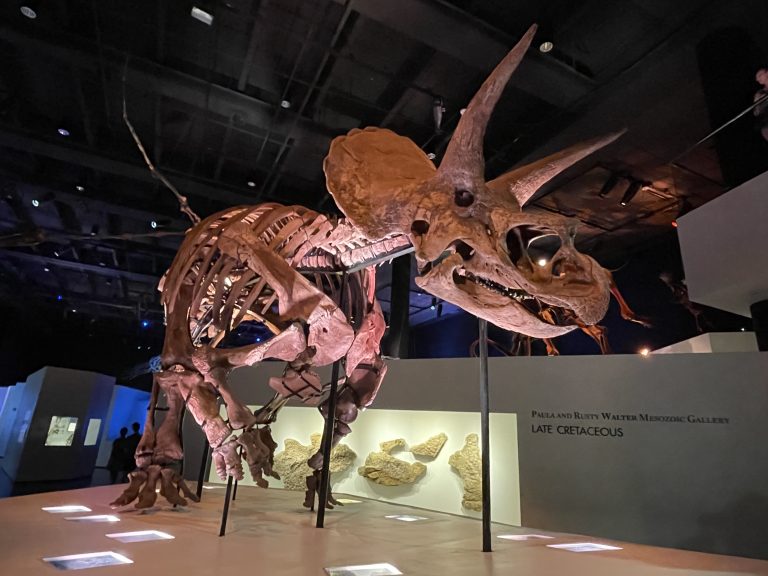
Triceratops horridus is one of the most recognizable horned dinosaurs. Equipped with two brow horns measuring up to 1 meter in length, a shorter nasal horn, and a solid parietal-squamosal frill, it was a dominant herbivore that actively defended against contemporary predators like Tyrannosaurus rex.
Velociraptor mongoliensis
Velociraptor mongoliensis
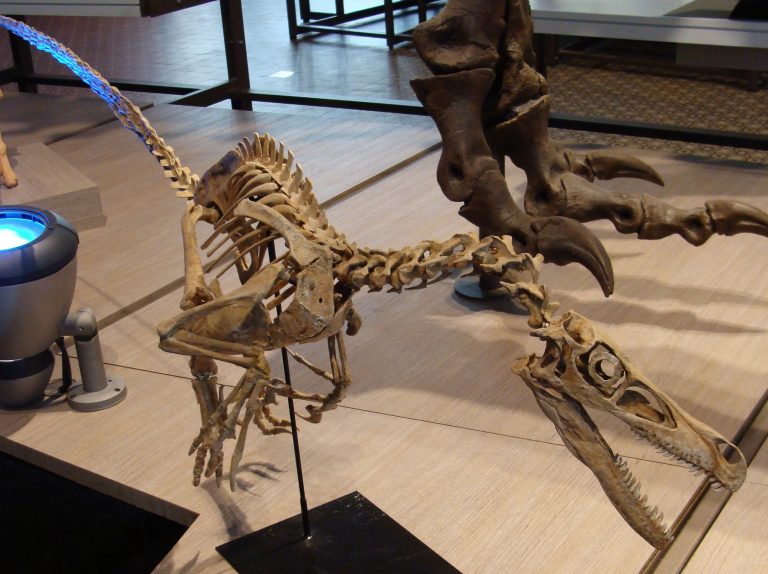
A turkey-sized feathered dromaeosaurid predator of the Gobi Desert, renowned for its hyperextensible sickle-shaped second toe claw and acute binocular hunting vision.
Gallimimus bullatus
Gallimimus bullatus
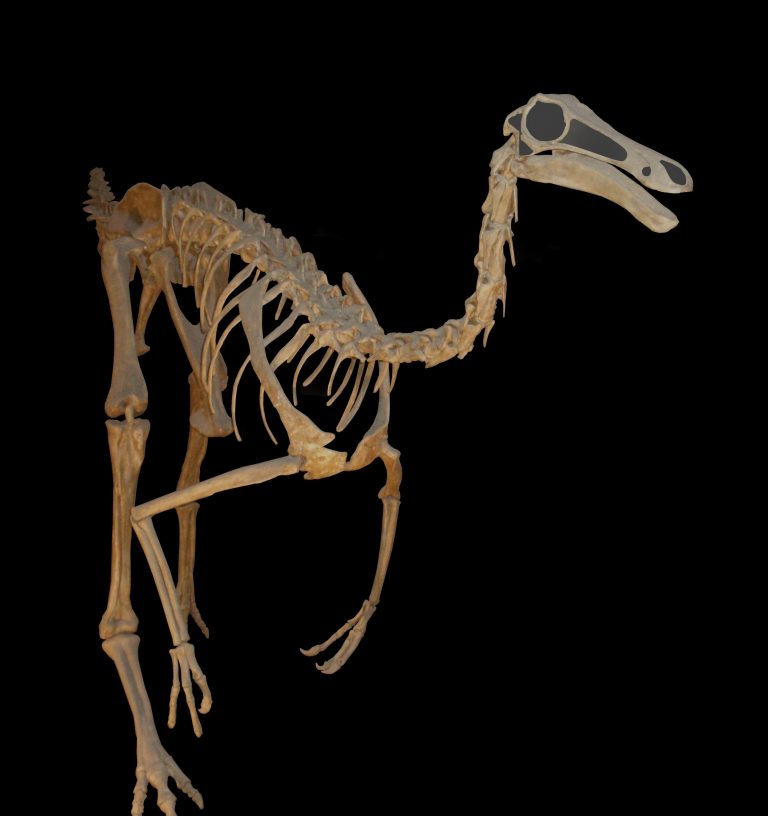
A fleet-footed ostrich-mimic theropod with a toothless keratinous beak suited for omnivorous grazing on vegetation, seeds, and small wetland invertebrates.
Related Paleontological Dispatches
Dinosaur News This Month: What Paleontologists Just Announced
Welcome to the October 2026 edition of Paleontological Dispatches, your curated, scientifically verified monthly roundup of what researchers…
The 10 Biggest Dinosaur Discoveries of the Last 5 Years
The last five years (2021–2026) represent one of the most prolific and intellectually transformative golden ages in the…

Why It Can Take 20 Years to Name a New Dinosaur
Whenever headlines announce that paleontologists have unveiled a spectacular new dinosaur species, the public naturally envisions a researcher…