Dinevenator robustus: The “Diné Hunter” — New Mexico’s Newly Named Bird-Like Dinosaur
A single skull bone, twenty years of mistaken identity, and a new thick-skulled predator for New Mexico's Late Cretaceous record.
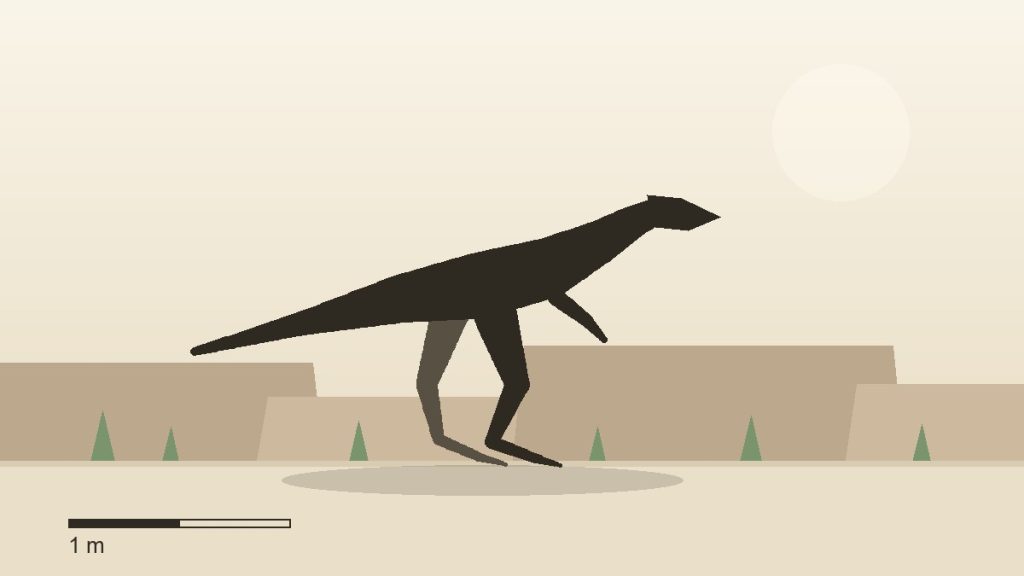
For twenty years, a single fossilized skull bone sat in a museum drawer under the wrong name. First it was called a raptor. Then it was declared scientifically useless. Then it was borrowed by another genus. In August 2026, paleontologists finally gave it the name it deserved: Dinevenator robustus, the “Diné hunter” — a thick-skulled, bird-like predator that stalked the floodplains of New Mexico some 73 million years ago.
This is the story of one of the most honestly earned new dinosaur names in recent years: what the fossil actually is, why it took two decades to identify, what “bird-like” really means, and what a lone skull bone can and cannot tell us.
Meet Dinevenator robustus: New Mexico’s Newly Named Bird-Like Dinosaur
Dinevenator robustus is a species of troodontid theropod — a family of small, bipedal, big-brained predatory dinosaurs closely related to birds. The genus name combines Diné, honoring the Navajo people of the American Southwest where the fossil was found, with the Latin venator, meaning “hunter.” The species name robustus refers to the animal’s unusually thick, heavily built skull bones.
The formal description was published on August 3, 2026, by Steven E. Jasinski of the New Mexico Museum of Natural History & Science and Robert M. Sullivan, a research associate of the museum, in the peer-reviewed journal Fossil Studies — a genuine addition to New Mexico’s fossil record, not a rebranding of an old favorite.
Working from comparisons with close relatives, the researchers estimate that Dinevenator measured roughly 2.5 to 3 meters (8 to 10 feet) long and weighed 70 to 140 kilograms (150 to 300 pounds). That would make it one of the larger troodontids known. But an important caveat runs through this entire article: those numbers are informed estimates, not measurements. The whole animal is known from a single bone.
A Fossil With Three Identities: The 20-Year Road to a Name
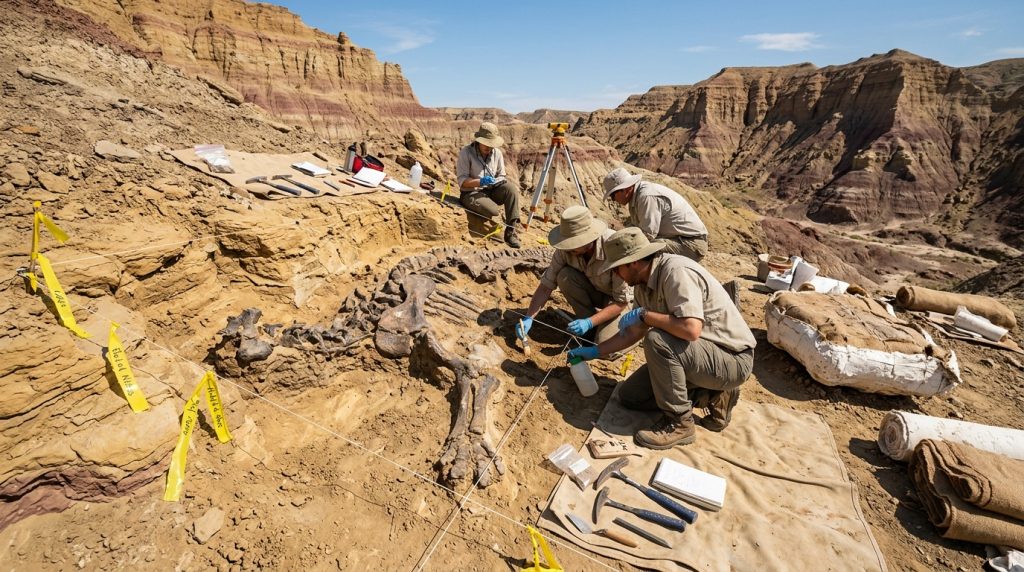
Few new dinosaurs arrive with as much taxonomic baggage as this one. The holotype specimen — catalogued as SMP VP-1955 and housed at the State Museum of Pennsylvania in Harrisburg — is a nearly complete left frontal, a bone from the roof of the skull. It was collected in the summer of 2005 by Robert Sullivan from the De-na-zin Member of the Kirtland Formation in the San Juan Basin of northwestern New Mexico.
What followed is a compressed lesson in how paleontology actually works:
- 2006: the raptor hypothesis. Sullivan described the frontal as a new species of the dromaeosaurid (raptor) Saurornitholestes, naming it Saurornitholestes robustus for its stout build. At the time, the referral seemed reasonable — small predatory theropods are notoriously hard to tell apart from isolated bones.
- 2012–2014: doubt sets in. A review of dromaeosaurids found no anatomical features tying the specimen to that family, and one study treated the name as a possible nomen dubium — a “dubious name” that cannot be confidently attached to a real animal. Other researchers recognized the bone as troodontid instead, but still questioned whether the species was valid.
- Early 2026: a borrowed genus. When researchers describing the Mexican troodontid Xenovenator espinosai re-examined the New Mexico frontal, they found genuine similarities — notably the thickened skull — and tentatively assigned it to that genus as Xenovenator(?) robustus, with an explicit question mark.
- August 2026: its own genus. Jasinski and Sullivan redescribed the specimen in detail, identified a suite of features separating it from Xenovenator and every other troodontid, and erected the new genus Dinevenator.
This history is worth knowing because it answers a question readers often ask: how can scientists name a whole dinosaur from one bone? They did not do it quickly or lightly. The specimen survived twenty years of skeptical re-examination, and each round of doubt forced a closer look at the anatomy.
Where and When It Lived: The Kirtland Floodplain, 73 Million Years Ago
Dinevenator comes from the De-na-zin Member of the Kirtland Formation, dated to the late Campanian stage of the Late Cretaceous — approximately 73.4 to 73.0 million years ago. It belongs to the Willow Wash local fauna of the Kirtlandian land-vertebrate age, a distinctive assemblage of animals found in the San Juan Basin.
Forget the modern desert. At the time, northwestern New Mexico was a wet, subtropical floodplain threaded with rivers, forests, and open landscapes dominated by conifers. Dinevenator shared this world with an impressive cast: the crested duckbill Parasaurolophus tubicen, armored ankylosaurs such as Nodocephalosaurus and Ziapelta, horned ceratopsids, dome-headed pachycephalosaurs such as Sphaerotholus, the small raptor Saurornitholestes sullivani, and large tyrannosaurs looming over them all.
That date matters. At roughly 73 million years old, Dinevenator lived about seven million years before the asteroid impact that ended the Cretaceous 66 million years ago. Every well-documented predator from this interval sharpens our picture of dinosaur diversity in their final chapters — the subject of our guide to the Hell Creek Formation’s final days, which preserves a slightly younger ecosystem.
What a Single Skull Bone Can (and Cannot) Tell Us
Here is where honest paleontology reporting must slow down. The entire known fossil record of Dinevenator robustus is one bone: a left frontal from the skull roof. No teeth, no jaws, no limbs, no vertebrae, no feathers. Everything below is therefore a hierarchy of confidence, and it helps to keep the levels separate.
What the bone directly shows
The frontal is genuinely distinctive, which is why the genus survived peer review. Compared with other troodontids, it is dorsoventrally thick and robust — thicker toward the back than the front — with a nearly flat upper surface that lacks the well-developed midline trough and ridge seen in relatives. The facet where the nasal bones met the frontal is wider than it is long, and the walls housing the brain and eye socket are proportioned differently from any known relative. Several of these traits are unique to this animal.
From the frontal alone, researchers can also confirm the troodontid identification itself: the shallow walls around the smell-processing region of the brain, the exclusion of a skull opening called the supratemporal fossa from the top of the frontal, and a raised rim around the eye socket are all anatomical signatures of the family.
What is reasonably inferred
Body size, diet, and lifestyle are reconstructed by phylogenetic bracketing — reasoning from the closest well-known relatives. Because troodontids share a common body plan (bipedal, long-legged, grasping hands, long stiff tail for balance), Dinevenator very probably shared it. The museum’s researchers describe the animal as likely omnivorous: small mammals, lizards, insects, possibly early birds, plus fruit and plants.
These are scientifically grounded inferences, but they are inferences. A future skeleton could revise them, and trustworthy reporting says so upfront.

Why Scientists Call It “Bird-Like” (Without Calling It a Bird)
“Bird-like dinosaur” is a phrase that causes constant confusion, so let us be precise about what researchers mean when they apply it to Dinevenator.
Troodontids belong to the maniraptoran theropods, the same broad lineage that produced birds. They are “bird-like” in specific anatomical senses: unusually large brains relative to body size, keen senses (large, forward-facing eyes in well-known relatives), lightweight build, wishbone-bearing chests, grasping three-fingered hands, and in several relatives, true feathers preserved in the fossil record. Our deep dive into how paleoart reconstructs feathers, scales, and color explains how scientists read this kind of evidence.
What “bird-like” does not mean here:
- It was not a bird. Dinevenator was a non-avian dinosaur — a ground-running predator, not a flyer. Nothing about the holotype suggests flight.
- Feathers are not proven in this species. No skin or feather impressions were found with the frontal. Feathers are a reasonable reconstruction hypothesis, inferred from feathered troodontid relatives, but they remain an inference, not an observation.
- “Bird-like” does not mean “direct ancestor of birds.” Troodontids are close cousins on the family tree, members of a lineage experimenting with bird-like traits — not a rung on a ladder leading to modern birds. Evolution branches; it does not climb.
The honest summary: Dinevenator was a member of the dinosaur family hovering closest to the origin of birds, built on the same anatomical themes — big brain, sharp senses, agile bipedal body — that birds would later take into the sky.
How Big Was It, and What Did It Probably Eat?
Among troodontids — a family famous for turkey-to-human-sized animals — Dinevenator appears to have been a heavyweight. The estimated 2.5 to 3 meters and up to 140 kilograms would place it among the largest known members of the group, and its thickened skull bones suggest a powerfully built animal. One museum description memorably calls it “beefy” for its kind.
Ecologically, it likely sat in the middle of the food web: large enough to take small vertebrates and raid nests, small enough to watch for tyrannosaurs. The proposed omnivorous diet fits a pattern seen across troodontids, whose varied teeth (in relatives where teeth are known) suggest flexible, opportunistic feeding.
Again, the confidence levels matter. The “beefy” skull is observed fact. The body mass is an estimate. The diet is an ecological inference. All three are worth reporting — clearly labeled.
Its Place in Dinosaur Evolution: Leader of the Robust Clan
The description paper did more than name a genus; it ran a phylogenetic analysis placing Dinevenator in the troodontid family tree. The result is genuinely interesting: Dinevenator emerged as the earliest-diverging member of a “robust-skulled” lineage of troodontins — a subgroup with thicker, more heavily built skulls than their slender relatives.
Its closest cousins in this robust clan are Albertavenator curriei from Canada and Xenovenator espinosai from Mexico. Arrayed against them is a “gracile” subgroup of more lightly built northern forms, including Troodon, Stenonychosaurus, and Latenivenatrix. Notably, the robust forms appear to be geologically younger than the slender forms — hinting at an evolutionary shift toward sturdier builds in Late Cretaceous North America, though the authors are careful to frame this as an emerging pattern rather than a settled trend.
The geography is equally suggestive. A robust troodontid lineage stretching from Canada through New Mexico to Mexico implies these predators were diversifying across regions — with the southern faunas of the San Juan Basin harboring their own distinctive forms. Compare fleet-footed relatives like Velociraptor mongoliensis, the famous dromaeosaurid Dinevenator was once mistaken for, or Archaeopteryx lithographica near the dinosaur–bird boundary, and the scale of troodontid diversity comes into focus.
Why This Discovery Matters for New Mexico
Dinevenator strengthens a case paleontologists have been building for years: that the San Juan Basin’s Kirtlandian faunas hosted dinosaur communities distinct from those farther north. Different dinosaur groups show closest ties to different regions, suggesting a complex patchwork of Late Cretaceous ecosystems rather than one uniform fauna stretching across the continent.
For New Mexico specifically, the find adds a large, robust predator to a roster that already includes icons like Coelophysis bauri — the state’s official fossil — and extends the state’s record of unique species found nowhere else. Each such discovery raises the scientific stakes of the basin’s badlands: these are not scraps of widespread species, but evidence of a homegrown fauna that evolved in place.
There is also a quieter significance. The holotype spent years in the collections of the State Museum of Pennsylvania, far from where it was dug up. Its renaming underscores why museums keep fossils accessible for re-study: new techniques, new comparative specimens, and new eyes can pull a new genus out of a drawer.
What Most People Get Wrong About “Bird-Like” Dinosaurs
The single biggest misconception is treating “bird-like” as a synonym for “basically a bird.” It is not. When paleontologists call Dinevenator bird-like, they mean it shares specific anatomical features with the lineage that produced birds — enlarged brain, keen vision, agile bipedal frame — not that it flew, nested like a robin, or sported a beak.
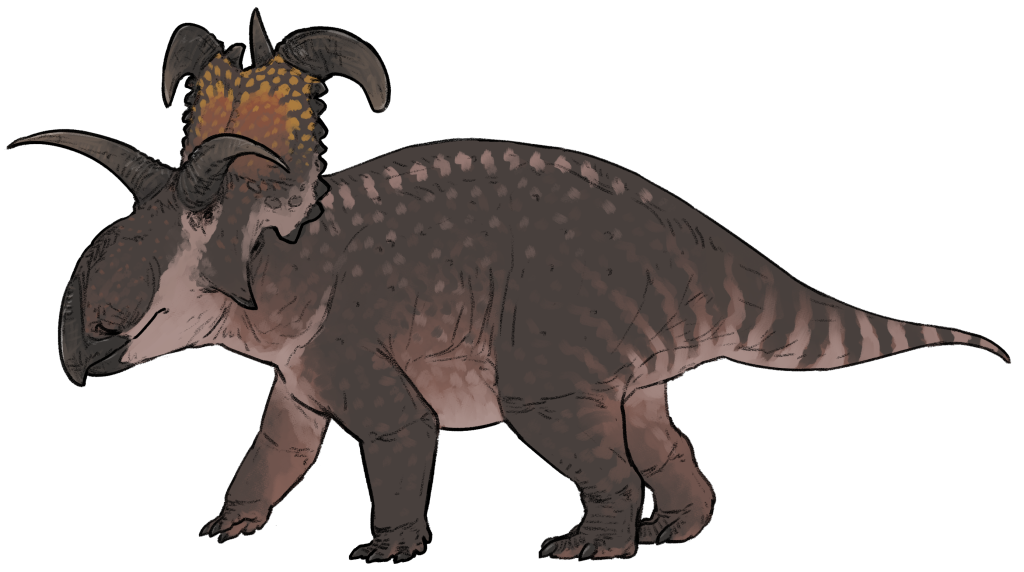
Three related errors follow from that one. First, assuming feathers are proven: they are plausible for Dinevenator, given feathered troodontid relatives, but no feathers were found, and artwork showing a fully feathered animal is reconstruction, not evidence. Second, confusing similarity with ancestry: troodontids are cousins near the origin of birds, not grandparents of them. Third, treating the reconstruction as the fossil: every life restoration of Dinevenator — including the artwork accompanying this article — is an educated portrait built on one skull bone plus relatives. The bone is the fact; the portrait is the hypothesis. Good dinosaur science, and good dinosaur journalism, never blurs that line.
Frequently Asked Questions
How do you pronounce Dinevenator robustus?
Approximately “din-EH-ven-AY-tor roh-BUS-tus.” The genus name honors the Diné (Navajo) people combined with the Latin word for hunter; the species name means robust or sturdy, referring to the animal’s thick skull bones.
When was Dinevenator robustus discovered?
The fossil was collected in the summer of 2005 by Robert Sullivan in the San Juan Basin. It was first described in 2006 as a raptor species, re-evaluated several times over the following two decades, and finally recognized as its own genus in a paper published August 3, 2026, in the journal Fossil Studies.
How big was Dinevenator robustus?
Based on comparisons with close relatives, researchers estimate 2.5 to 3 meters (8 to 10 feet) long and 70 to 140 kilograms (150 to 300 pounds) — large for a troodontid. These are estimates, not direct measurements, because only a single skull bone is known.
Was Dinevenator a raptor like Velociraptor?
No — although it was originally mistaken for one. Detailed anatomy places it in Troodontidae, a separate family of bird-like theropods. Troodontids and dromaeosaurids (“raptors”) are related maniraptorans, but they differ in skull construction, teeth, and proportions. You can compare with our profile of the real Velociraptor to see the difference.
Did Dinevenator have feathers?
Unknown. No feathers or skin impressions were preserved with the single known fossil. Feathers are plausible because several troodontid relatives were feathered, but any feathered portrait of Dinevenator is a reconstruction hypothesis, not observed evidence.
Where can I see the Dinevenator fossil?
The holotype (SMP VP-1955) is accessioned at the State Museum of Pennsylvania in Harrisburg. The species was described by scientists at the New Mexico Museum of Natural History & Science in Albuquerque, which is the best place to follow future research and related San Juan Basin discoveries.
Final Takeaway
Dinevenator robustus is a modest fossil with an outsized lesson: a single skull bone, studied patiently for twenty years, survived misidentification, dismissal, and reassignment to emerge as a genuinely new branch on the troodontid family tree — a big, thick-skulled, probably omnivorous predator that adds a southern stronghold to a lineage stretching from Canada to Mexico. It reminds us that dinosaur discovery is not only about dramatic new digs; sometimes it is about looking harder at what is already in the drawer.
Want to place Dinevenator in deep time? Explore our interactive Mesozoic timeline, browse the full dinosaur encyclopedia, or start with the fundamentals in the Learn Hub — and keep watching New Mexico’s badlands. If one drawer held a new dinosaur for twenty years, others may too.
Scientific Sources & Peer-Reviewed Literature

Referenced Dinosaur Species 4 species
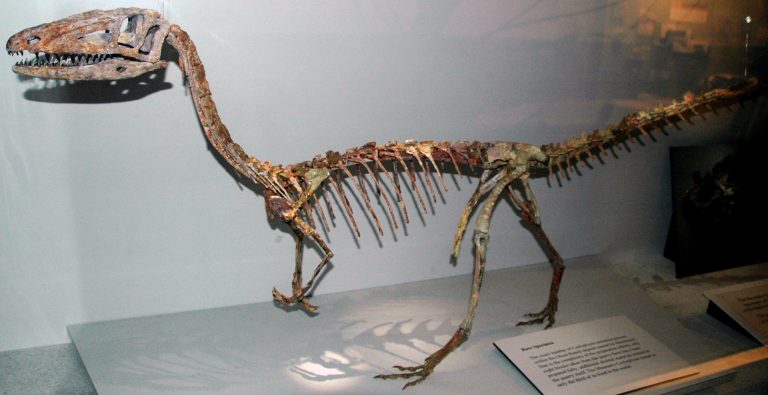
Coelophysis bauri
Coelophysis bauri
A gracile, agile early theropod that flourished across Late Triassic floodplains, hunting small vertebrates and insects with slender grasping jaws and lightweight hollow bones.
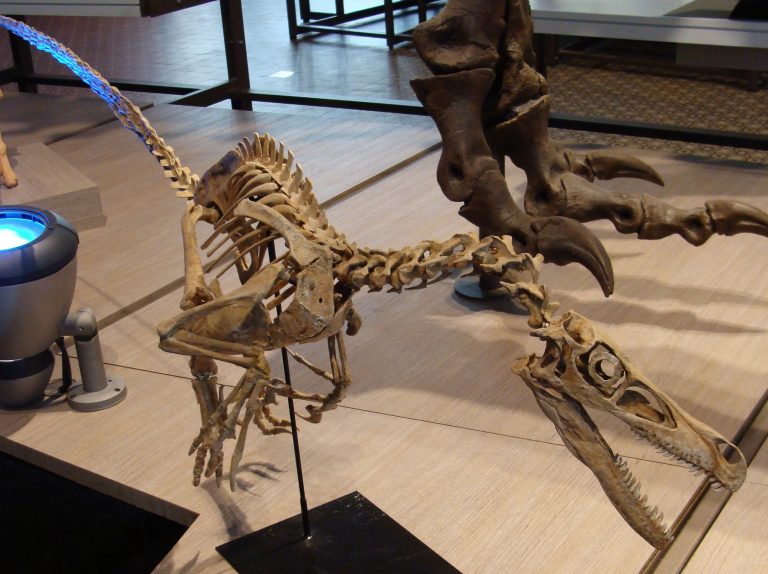
Velociraptor mongoliensis
Velociraptor mongoliensis
A turkey-sized feathered dromaeosaurid predator of the Gobi Desert, renowned for its hyperextensible sickle-shaped second toe claw and acute binocular hunting vision.

Archaeopteryx lithographica
Archaeopteryx lithographica
The historic transitional fossil bridging non-avian feathered theropods and modern birds, possessing feathered wings alongside toothed jaws and a bony tail.
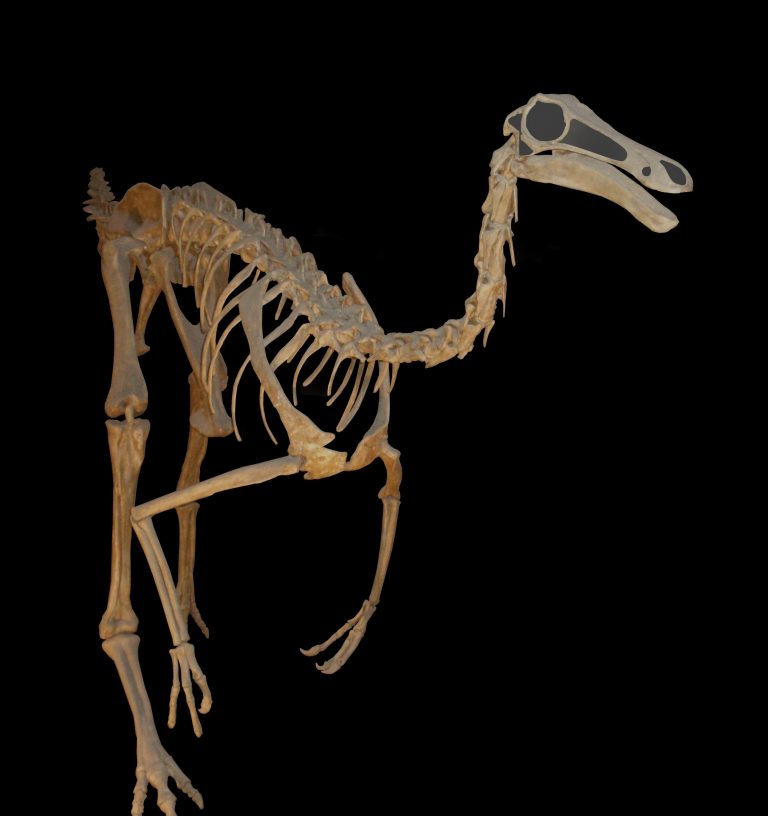
Gallimimus bullatus
Gallimimus bullatus
A fleet-footed ostrich-mimic theropod with a toothless keratinous beak suited for omnivorous grazing on vegetation, seeds, and small wetland invertebrates.
Related Paleontological Dispatches
Dinosaur News This Month: What Paleontologists Just Announced
Welcome to the October 2026 edition of Paleontological Dispatches, your curated, scientifically verified monthly roundup of what researchers…
The 10 Biggest Dinosaur Discoveries of the Last 5 Years
The last five years (2021–2026) represent one of the most prolific and intellectually transformative golden ages in the…

Why It Can Take 20 Years to Name a New Dinosaur
Whenever headlines announce that paleontologists have unveiled a spectacular new dinosaur species, the public naturally envisions a researcher…