How Scientists Name a New Dinosaur Species, Step by Step
Naming a dinosaur is not an exercise in creative branding—it is a strict, legally binding scientific protocol governed by the International Code of Zoological Nomenclature. Here is the step-by-step journey from badlands bedrock to taxonomic permanence.
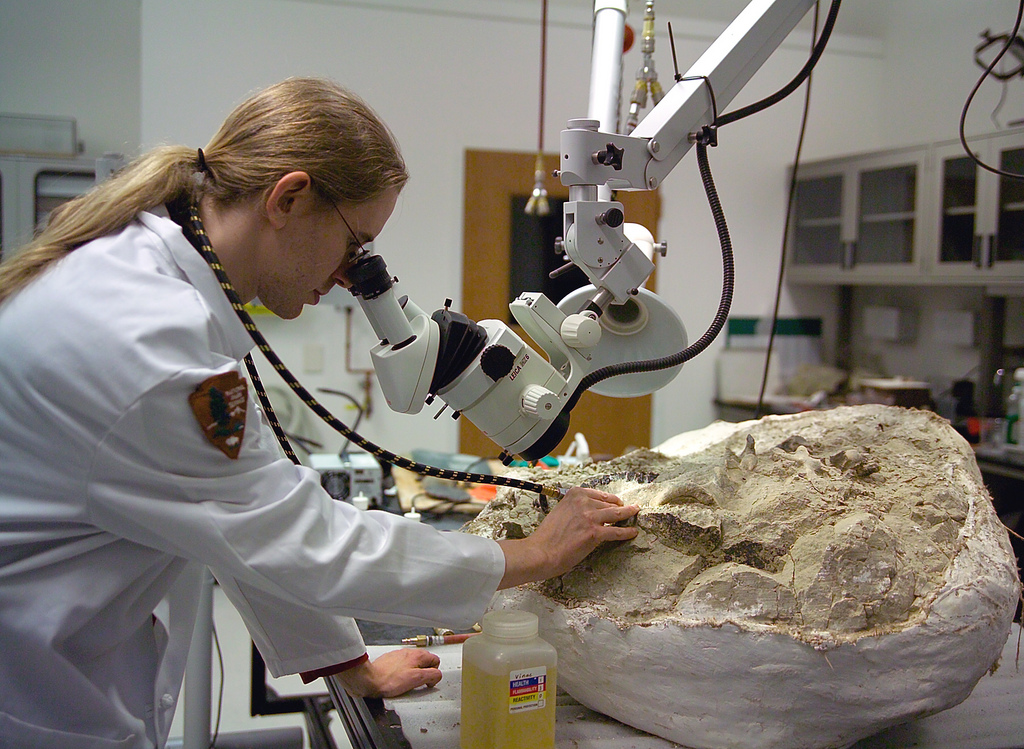
In popular culture, discovering and naming a dinosaur is often imagined as a sudden, poetic epiphany: a paleontologist brushes away desert sand, unearths a towering claw, and immediately declares a brand-new prehistoric monster. In reality, naming a new dinosaur is one of the most demanding, regulated, and scrutinizing endeavors in the biological sciences.
You cannot simply invent a catchy Latin moniker and declare it valid. Every valid dinosaur genus and species on Earth must adhere to the rigorous rules established by the International Code of Zoological Nomenclature (ICZN). Naming a new dinosaur is not a branding exercise; it is the publication of an empirical scientific hypothesis that must withstand decades of peer review, museum replication, and evolutionary re-evaluation.
From the moment a weathered bone fragment is flagged in the field to the formal timestamping of a digital monograph in ZooBank, here is the exact, step-by-step scientific workflow that paleontologists must follow to name a new dinosaur species.
The Taxonomic Pipeline: 7 Mandatory Stages
- 1. Provenance: Geological discovery & GPS mapping
- 2. Preparation: Mechanical & chemical rock extraction
- 3. Digital Osteology: Micro-CT scanning & 3D modeling
- 4. Differential Diagnosis: Identifying unique autapomorphies
- 5. Type Designation: Selecting the permanent Holotype
- 6. Binominal Etymology: ICZN Latin/Greek name formation
- 7. Peer-Reviewed Publication: ZooBank registration & archiving
Step 1: Discovery and Stratigraphic Provenance
The taxonomic journey begins in the field, but finding a bone is only half the battle. Without precise stratigraphic provenance, a fossil is virtually useless to taxonomy. Paleontologists must meticulously record:
- Precise Geospatial Coordinates: Exact GPS coordinates of the quarry site, often kept in secure museum archives to deter poaching on public or tribal lands.
- Stratigraphic Horizon: The exact geological formation, member, and sedimentary bed in which the fossil was entombed. Knowing whether a specimen lay above or below a volcanic bentonite ash layer allows radiometric dating (e.g., argon-argon or uranium-lead dating).
- Taphonomic Context: Was the animal buried in a slow-moving river floodplain, an ancient sand dune collapse, or a catastrophic volcanic ashfall? This dictates which bones are preserved and whether multiple individuals represent a single species or a mixed bonebed.
Fossils excavated without legal permits or reliable geological provenance can rarely be accepted by reputable scientific journals, because their evolutionary age and provenance cannot be verified.
Step 2: Stabilization and Laboratory Preparation
Once encased in protective plaster and burlap “field jackets,” multi-ton fossil blocks are transported to museum paleontology labs. Here begins the preparation stage—often the longest bottleneck in the entire process.
Specialized fossil preparators use pneumatic air scribes (miniature jackhammers the size of pens), dental picks, micro-abrasive air-blasters with sodium bicarbonate, and dilute organic acids (such as acetic or formic acid for limestone matrices) to slowly remove surrounding rock grain by grain. During preparation, consolidants like polyvinyl butyral (Butvar) or Paraloid B-72 are applied to penetrate and stabilize fractured bone. A single dinosaur skull can easily require 2,000 to 5,000 hours of laboratory preparation before its diagnostic sutures and internal braincase cavities become visible.
Step 3: Comparative Anatomy and Identifying Autapomorphies
Once the skeleton is cleaned, the lead researcher must answer the ultimate taxonomic question: Is this genuinely something new, or is it merely an unusually large, small, or deformed individual of an already-named dinosaur?
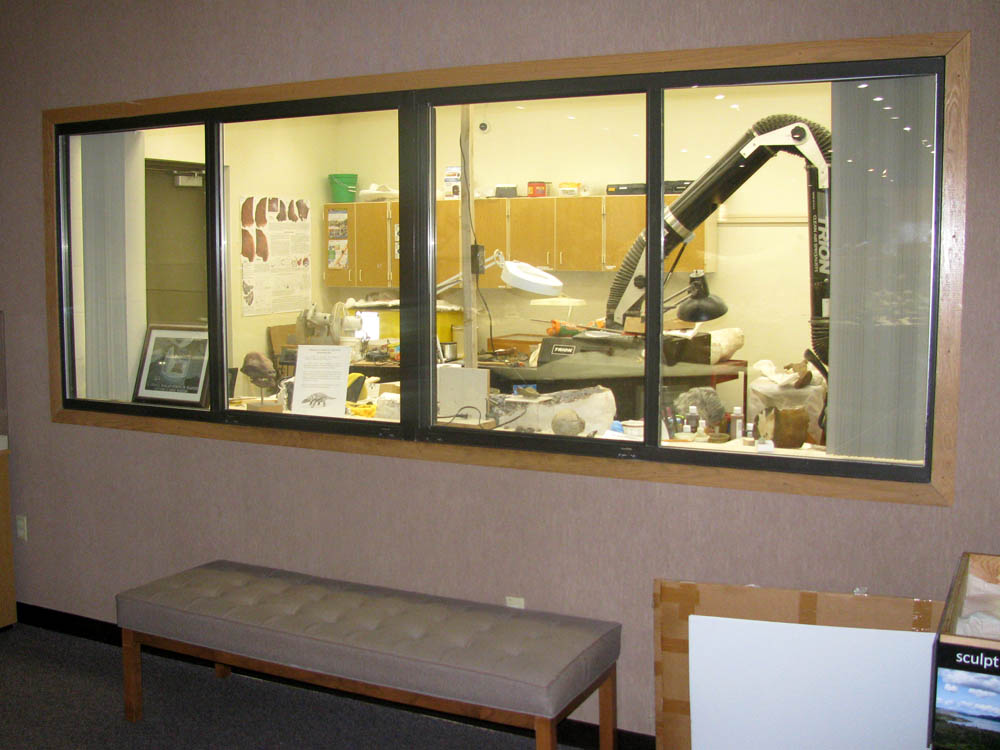
To justify a new genus or species, researchers must formulate a differential diagnosis. This requires discovering autapomorphies—unique derived anatomical characteristics found in this animal and nowhere else in the known fossil record. For example:
- A specific crest or ridge on the surangular bone of the lower jaw.
- An unprecedented arrangement of air-filled pneumatic cavities (pleurocoels) inside the cervical vertebrae.
- A distinct ratio of metacarpal finger bones or an unusual angle of the femoral head.
Paleontologists travel to museum collections worldwide—from the Smithsonian in Washington to the IVPP in Beijing or the Natural History Museum in London—to physically inspect and measure related type fossils. Today, high-resolution micro-CT scanning and synchrotron radiation allow scientists to digitally inspect internal tooth-replacement patterns, middle-ear cavities, and cranial nerve canals without physically damaging the specimen.
Step 4: Designating the Holotype (The Name-Bearer)
Under the ICZN, every newly described animal species must have an objective, physical anchor to which its name is forever tied: the Holotype. The holotype is the single reference specimen that scientifically embodies the species.
Key rules govern the designation of a holotype:
- Public Institutional Repository: The holotype must be permanently deposited in an accessible, accredited non-profit museum or public university collection (such as the American Museum of Natural History, Carnegie Museum, or Field Museum). It can never remain in private hands, because commercial owners can restrict researcher access, sell the bone, or lose it to history.
- Specimen Catalog Number: The specimen must receive a permanent, unique institutional specimen identifier (for example, FMNH PR 2081 for the famous T. rex specimen “Sue”, or CM 31368 for Ptychotherates).
- Paratypes: If additional specimens from the same quarry display complementary anatomy (such as a limb bone or tail found alongside a holotype skull), they may be designated as paratypes to provide a broader picture of individual variation.
Step 5: Binominal Etymology: Crafting the Name
Under the Linnaean system of binominal nomenclature (formalized by Carl Linnaeus in the 18th century and regulated by ICZN Code Articles 11–34), every species name consists of two Latinized words:
Format: Genus species
- Genus (Capitalized, Italicized): Must be unique across the entire animal kingdom. No two animal genera on Earth can share the same name (the rule of homonymy).
- Specific Epithet (Lowercase, Italicized): The species-level descriptor. Must grammatically agree in gender (masculine, feminine, or neuter) with the genus if formed as an adjective.
Where Do the Names Come From?
Authors have substantial creative latitude in choosing the etymology, provided the name is spelled in the Latin alphabet and treats Latin or Greek grammatical roots correctly:
- Anatomy / Descriptive: Triceratops horridus translates from Greek and Latin as “rough three-horned face.” Ptychotherates bucculentus translates as “fold hunter with full cheeks.”
- Geographic / Formation: Argentinosaurus huinculensis honors Argentina and the Huincul Formation where it was discovered.
- Honoring Indigenous Heritage: Modern paleontology increasingly turns to Indigenous languages. In 2026, Dinevenator honors the Diné (Navajo) people of New Mexico, while Kank honors the Tehuelche mythic rhea of Patagonia.
- Honoring Scientists or Collectors: The species name often ends in -i for a man, -ae for a woman, or -orum for a group. Coelophysis bauri honors preparator George Baur; Yuxisaurus kopchicki honors benefactor John Kopchick.
Step 6: Writing the Monograph and Surviving Peer Review
Naming a dinosaur is not an announcement on social media or a television documentary. It requires writing an exhaustive scientific monograph—often 50 to 200 pages long—describing every individual bone, tooth, and groove in agonizing osteological detail.
The manuscript must include:
- Systematic Paleontology Section: Clear taxonomic hierarchy (Dinosauria → Saurischia/Ornithischia → Family → Genus → Species).
- Etymology & Holotype Designation: Formal declaration of the name meaning and museum catalog number.
- Differential Diagnosis: A bulleted list of characteristics proving why this taxon differs from all other known dinosaurs.
- Detailed Osteological Description: Precise millimetric measurements, high-resolution photographic plates with scale bars, and bone suture maps.
- Phylogenetic Analysis: A computer-generated evolutionary tree (cladogram) testing where the new dinosaur branches on the family tree based on a character-taxon matrix of hundreds of skeletal traits.
The paper is submitted to a peer-reviewed academic journal (such as the Journal of Vertebrate Paleontology, Zoological Journal of the Linnean Society, Nature, or Palaeontology). The journal editor assigns two to four independent external paleontologists to dissect every claim, examine the photos, and critique the cladogram. Reviewers may challenge the diagnosis, demand re-preparation of certain sutures, or insist that the specimen is merely a synonym of an existing dinosaur. This peer review process routinely takes six months to two years.
Step 7: Official ICZN Registration in ZooBank
Since the historic ICZN Amendment of 2012, electronic-only publications (such as online journals) are fully valid under international law, but only if they comply with a crucial legal prerequisite: mandatory pre-registration in ZooBank.
ZooBank is the official online registry of the International Commission on Zoological Nomenclature. Before publication, the authors or journal editors must register:
- The exact proposed genus and species names.
- The title, authors, and ISSN of the publishing journal.
- A persistent Life Science Identifier (LSID), a unique alphanumeric code (e.g.,
urn:lsid:zoobank.org:act:...).
This LSID must be physically printed inside the published monograph. If an electronic paper is published without a valid ZooBank registration, the name is technically a nomen nudum (a “naked name”) and holds zero scientific or nomenclatural validity!
Post-Publication Scrutiny: Synonyms and Taxonomic Revisions
Publishing a name does not guarantee it will survive forever. Science is self-correcting, and once a name enters the scientific record, the global paleontological community begins testing it against new discoveries:
| Taxonomic Status | Scientific Definition | Classic Dinosaur Example |
|---|---|---|
| Valid Taxon | Distinct genus/species supported by clear autapomorphies and recognized holotype. | Tyrannosaurus rex Osborn, 1905 |
| Junior Synonym | A name published after an identical species was already named. Under the Principle of Priority, the older name wins. | Dynamosaurus imperiosus (named in 1905, published pages after T. rex, hence a junior synonym). |
| Nomen Dubium | A “doubtful name” based on a holotype that is too fragmentary or weathered to provide diagnostic autapomorphies. | Trachodon mirabilis (named from isolated duck-billed dinosaur teeth that could belong to multiple species). |
| Nomen Nudum | A “naked name” mentioned in media or conferences without formal description, diagnosis, or ZooBank registration. | Informal nicknames appearing in press releases before monograph publication. |
Common Mistakes and Misconceptions About Naming Dinosaurs
Misconception 1: “Anyone who finds a fossil gets to name it whatever they want.”
Reality: Amateur discoverers do not have the automatic right to name species. Naming requires an accredited author publishing an ICZN-compliant monograph. Reputable scientists often consult discoverers out of courtesy, but naming rights cannot be bought or casually assigned.
Misconception 2: “Scientists can name a dinosaur after themselves.”
Reality: While not explicitly forbidden by the ICZN, naming a species after oneself is widely considered a severe breach of academic ethics and professional etiquette. Paleontologists name species in honor of colleagues, Indigenous groups, institutions, or geological regions—never their own vanity.
Misconception 3: “Once named, a dinosaur’s name is set in stone forever.”
Reality: Taxonomic names are dynamic scientific hypotheses. If a new study proves that two different dinosaurs are actually male and female of the same species, or represent a juvenile and an adult (as seen in ontogenetic debates), one name may be synonymized or revised.
Frequently Asked Questions
Can a private collector name a dinosaur?
No. Under the International Code of Zoological Nomenclature, a holotype specimen must be accessible to the scientific community in a recognized public museum or institutional repository. Specimens held in private collections cannot serve as valid holotypes because scientific verification cannot be guaranteed.
How long does it take from finding a fossil to publishing its name?
On average, it takes between 5 to 20 years. Delicate excavation, thousands of hours of mechanical preparation in laboratory conditions, comparative research across global museum collections, and peer review require extensive time and funding.
What happens if two scientists discover the same dinosaur and name it differently?
The ICZN enforces the Principle of Priority: the earliest validly published name takes precedence (the senior synonym). The later name becomes a junior synonym and is retired from official scientific use, even if the later paper had a more famous author.
Why are dinosaur names always written in Latin or Greek?
Binominal nomenclature was established in the 18th century when Latin was the universal language of European scholarship. Today, Latin remains the international legal language of taxonomy because it is an unchanging “dead language,” ensuring consistency across all languages and cultures without national favoritism.
What is ZooBank, and why is it mandatory?
ZooBank is the official online register of the ICZN. Since 2012, any paper published in an electronic journal must register the work and the new names in ZooBank prior to release, embedding a permanent Life Science Identifier (LSID) in the paper to prevent fraudulent or unindexed publications.
Final Takeaway: A Universal Language of Deep Time
Naming a dinosaur is far more than a naming ceremony. It is the formal introduction of a long-lost biological organism to the annals of natural history. By establishing a rigorous, universal standard of holotypes, comparative autapomorphies, and legal ICZN registration, scientists ensure that whether a fossil was discovered in 1824 or 2026, researchers anywhere on the planet can communicate with total taxonomic clarity.
The next time you read a headline announcing a newly christened prehistoric beast, you can appreciate the immense journey that made that name possible: thousands of hours of lab preparation, decades of comparative anatomical study, and the unyielding precision of the scientific method.
To dive deeper into dinosaur classification, explore our Dinosaur Encyclopedia, trace the evolution of famous clades on our Geological Timeline, or explore our educational articles on Paleontological Science.
Key References & Nomenclatural Standards
- International Commission on Zoological Nomenclature. (1999). International Code of Zoological Nomenclature (4th ed.). The International Trust for Zoological Nomenclature, London.
- ICZN. (2012). Amendment of Articles 8, 9, 10, 21 and 78 of the International Code of Zoological Nomenclature to expand and refine methods of publication. Bulletin of Zoological Nomenclature, 69(3): 161–169.
- Benton, M. J. (2010). Naming dinosaur species: The performance of prolific authors. Journal of Vertebrate Paleontology, 30(2): 368–377. DOI: 10.1080/02724631003618195
- Padian, K. (2013). How to name a dinosaur. Nature, 499: 418. DOI: 10.1038/499418a
- Winston, J. E. (1999). Describing Species: Practical Taxonomic Procedure for Biologists. Columbia University Press, New York.

Referenced Dinosaur Species 5 species
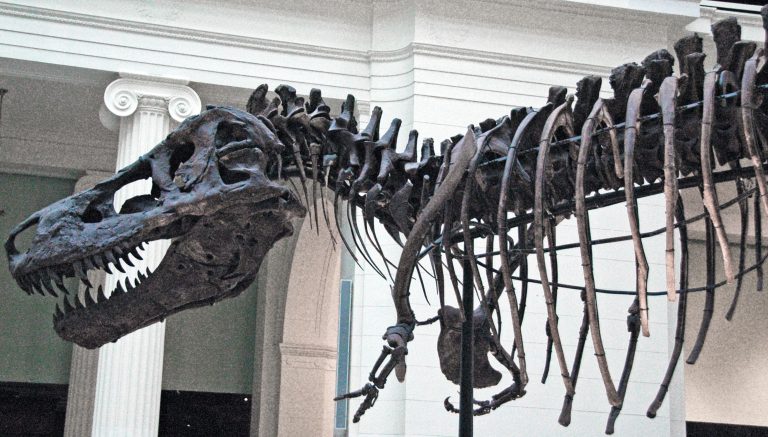
Tyrannosaurus rex
Tyrannosaurus rex
Tyrannosaurus rex was one of the largest terrestrial carnivores of all time, roaming western North America just prior to the Cretaceous-Paleogene extinction event. With an estimated bite force exceeding 35,000 Newtons and acute stereoscopic vision, it sat uncontested at the apex of its ecosystem.
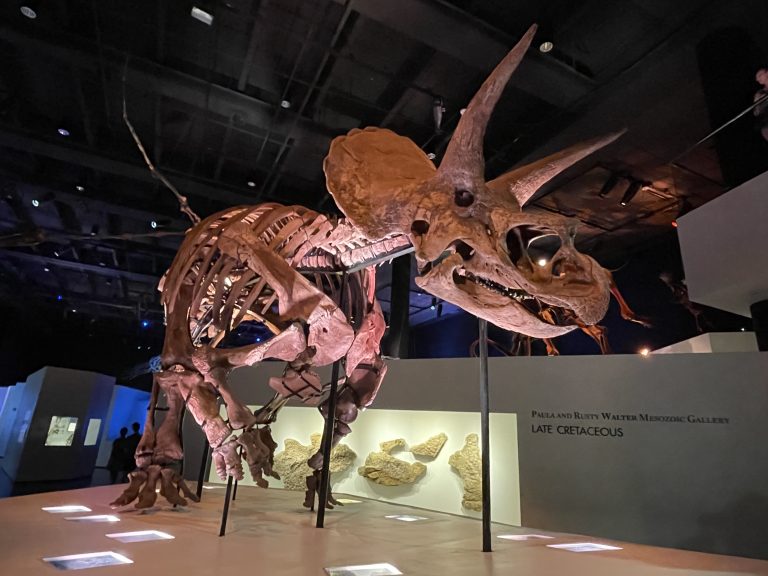
Triceratops horridus
Triceratops horridus
Triceratops horridus is one of the most recognizable horned dinosaurs. Equipped with two brow horns measuring up to 1 meter in length, a shorter nasal horn, and a solid parietal-squamosal frill, it was a dominant herbivore that actively defended against contemporary predators like Tyrannosaurus rex.
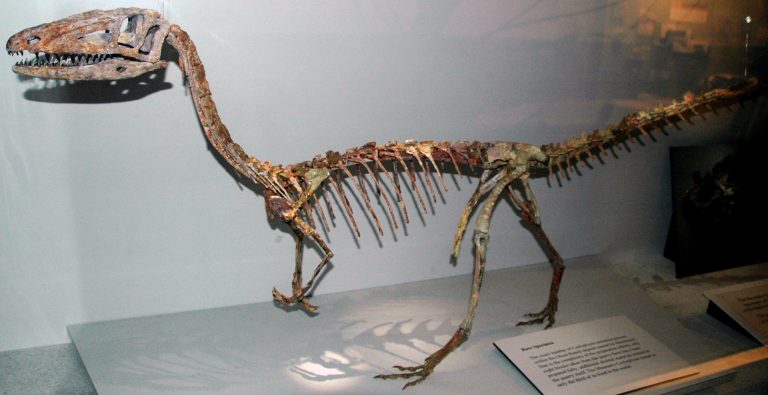
Coelophysis bauri
Coelophysis bauri
A gracile, agile early theropod that flourished across Late Triassic floodplains, hunting small vertebrates and insects with slender grasping jaws and lightweight hollow bones.
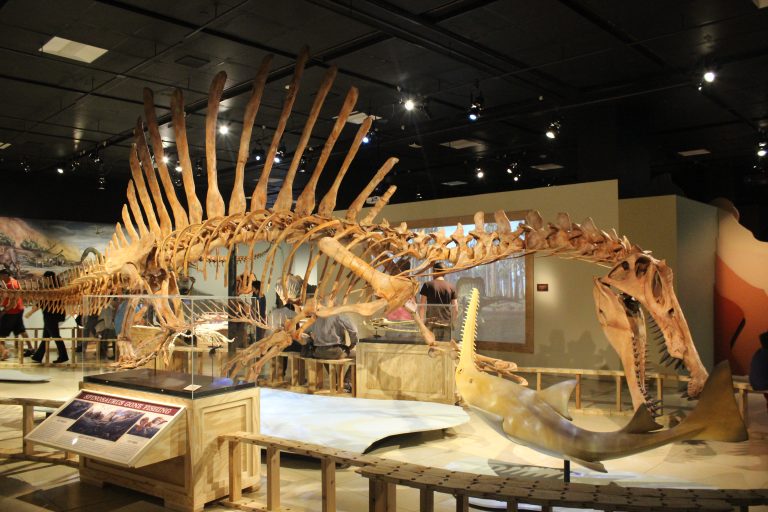
Spinosaurus aegyptiacus
Spinosaurus aegyptiacus
A colossal semi-aquatic predatory theropod equipped with a massive dorsal neural sail, crocodyliform snout, and paddle-like tail adapted for pursuing giant Cretaceous fish.

Archaeopteryx lithographica
Archaeopteryx lithographica
The historic transitional fossil bridging non-avian feathered theropods and modern birds, possessing feathered wings alongside toothed jaws and a bony tail.
Related Paleontological Dispatches
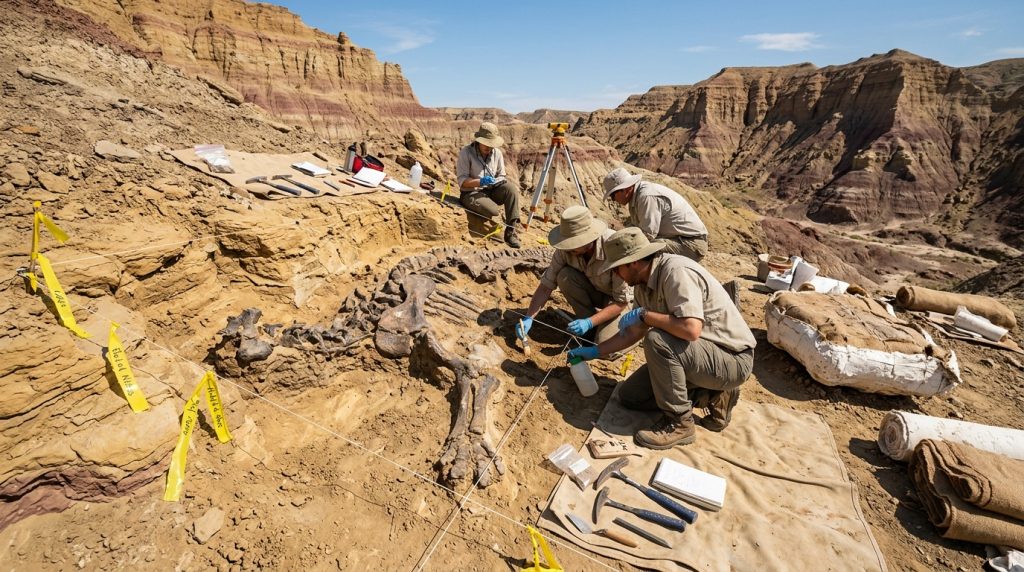
Dinosaur News This Month: What Paleontologists Just Announced
Welcome to the October 2026 edition of Paleontological Dispatches, your curated, scientifically verified monthly roundup of what researchers…
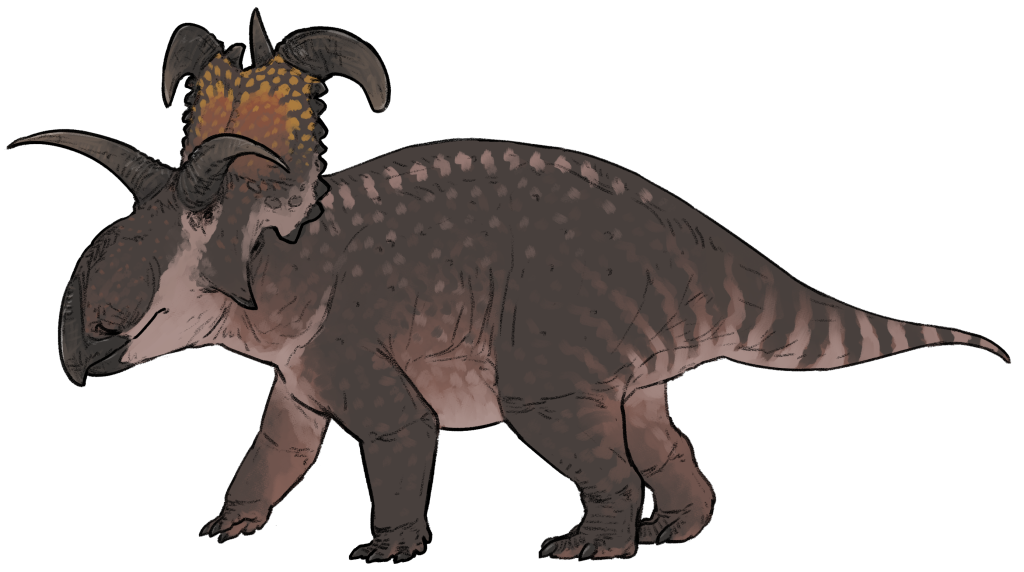
The 10 Biggest Dinosaur Discoveries of the Last 5 Years
The last five years (2021–2026) represent one of the most prolific and intellectually transformative golden ages in the…

Why It Can Take 20 Years to Name a New Dinosaur
Whenever headlines announce that paleontologists have unveiled a spectacular new dinosaur species, the public naturally envisions a researcher…