The ‘Peacock-Tailed’ Dinosaur: What China’s 120-Million-Year-Old Fossil Reveals
Discovered in the 120-million-year-old Jiufotang Formation of Liaoning, Changzhousaurus sinensis stunned paleontologists with an unprecedented fan of 16 tail plumes—shedding new light on the origins of dinosaur flight and sexual display.

In June 2026, scientific dispatches announced the formal description of a remarkable prehistoric creature hailing from the fossil-rich shales of northeastern China: Changzhousaurus sinensis. Hailed across international science media as the “peacock-tailed dinosaur,” this pigeon-sized, four-winged predator lived approximately 120 million years ago during the Early Cretaceous. Yet behind the colorful headlines lies an extraordinary evolutionary revelation: specimen LDNHMF 2026 preserves a symmetrical distal fan of sixteen long, pennaceous tail plumes—a morphology never before documented alongside four-winged locomotion—offering paleontologists a vital key to deciphering how early dinosaurs balanced aerodynamic control with dazzling visual display.
?? Specimen At-A-Glance: Changzhousaurus sinensis
1. The Discovery in Liaoning: What Was Actually Found?
The fossil bed that yielded Changzhousaurus sinensis is no ordinary rock outcrop. It was recovered from the famous Jiufotang Formation in Liaoning Province, northeastern China—the crown jewel of the Early Cretaceous Jehol Biota. For three decades, the fine-grained volcanic ash and lakebed siltstones of Liaoning have yielded some of the most spectacular feathered fossils on Earth, capturing everything from downy proto-feathers on tyrannosauroids to delicate melanosomes preserving ancient plumage color.
The holotype specimen, split across part and counterpart slabs (cataloged as LDNHMF 2026A and 2026B at the Lande Museum of Natural History, with research casts preserved at the Institute of Vertebrate Paleontology and Paleoanthropology [IVPP] in Beijing), preserves a virtually complete, articulated skeleton of a tiny theropod dinosaur. Surrounding the delicate bones are extensive carbonized films of soft tissue, displaying plumage along the neck, trunk, forelimbs, hindlimbs, and tail with breathtaking clarity.
The research team, led by world-renowned paleontologist Dr. Xu Xing—the scientist who originally introduced four-winged dinosaurs to the world with Microraptor gui in 2003—recognized immediately that this specimen did not fit neatly into known categories. While its skeleton exhibited the classic anatomical markers of a microraptorine dromaeosaurid, its caudal plumage showcased an unprecedented, expansive feather fan that immediately sparked comparisons to modern display birds.
2. What Dinosaur Is It? Meeting Changzhousaurus sinensis
It is vital to establish first what the animal is—and what it is not. “Peacock-tailed dinosaur” is an informal descriptive phrase popularized by headline writers and researchers to communicate its unusual tail shape; it is not the animal’s formal taxonomic name.
The valid scientific name established in Vertebrata PalAsiatica is Changzhousaurus sinensis. The genus name, Changzhousaurus, honors the city of Changzhou in Jiangsu Province for its enduring institutional support of paleontological education, dinosaur exhibitions, and evolutionary research. The species name, sinensis, is Latin for “from China.”
Phylogenetically, Changzhousaurus sits securely within Pennaraptora, a major evolutionary clade of theropod dinosaurs that includes oviraptorosaurs, dromaeosaurids, troodontids, and modern birds (Aves). Within Pennaraptora, detailed anatomical matrices place it in the family Dromaeosauridae, closely related to Microraptor, Sinornithosaurus, and Wulong. It is a genuine non-avian dinosaur, not a modern bird, despite possessing fully developed pennaceous flight feathers.
3. Where and When Did It Live? The 120-Million-Year-Old Jehol World
Geochronological dating using radiometric argon-argon (40Ar/39Ar) analysis of volcanic ash layers places the fossil beds of the Jiufotang Formation precisely at the Aptian stage of the Early Cretaceous period, approximately 120 million years ago. The claim of a “120-million-year-old feathered find” is thus fully supported by robust radiometric geology.
During the Aptian, northeastern China was an inland paradise of temperate conifer forests, freshwater lakes, and active volcanic arcs. The climate was cool and seasonal, with mild summers and chilly winters. Dense groves of ancient ginkgoes (Ginkgoites), seed ferns, and towering conifers (Podozamites and Pityocladus) bordered sprawling lake systems.
This lush forest canopy was home to a thriving community of small aerial animals: primitive avialans like Confuciusornis, early enantiornithine birds, pterosaurs like Sinopterus, tree-climbing mammals, and gliding dromaeosaurs. Periodic volcanic eruptions showered the lakes in fine ash clouds, smothering aquatic organisms and quickly burying fallen forest creatures on the quiet lakebed floor, preserving their delicate feathers in anoxia before bacteria or scavengers could destroy them.
4. Why Is It Called the “Peacock-Tailed” Dinosaur?

The “peacock” analogy arose because of the specific arrangement, symmetry, and sheer abundance of feathers on the creature’s tail. In classic dromaeosaurids like Velociraptor or Deinonychus, the bony tail is a long, stiff rod bound by interlocking ossified tendons, terminating in an unassuming bundle of feathers or scales. In four-winged dinosaurs like Microraptor, the tail typically sports a teardrop-shaped or diamond-shaped frond of feathers along the sides of the distal vertebrae, forming a narrow aerodynamic vane.
Changzhousaurus breaks that mold entirely. At the distal end of its tail, the fossil preserves approximately 16 long, symmetrical pennaceous feathers that radiate outward and backward from the caudal vertebrae, forming a broad, fan-like plumage array. Rather than an aerodynamic diamond, the tail feathers form a wide, rounded semicircle that bears an uncanny resemblance to the fan-shaped tail display of a miniature peacock or pheasant.
| Dinosaur / Prehistoric Avian | Geological Age & Formation | Tail Plumage Morphology | Inferred Function |
|---|---|---|---|
| Microraptor gui | ~120 Ma (Jiufotang) | Diamond / teardrop-shaped frond along distal tail | Pure aerodynamic flight stabilizer & pitch control |
| Yuanchuavis kompsosoura | ~120 Ma (Jiufotang) | Two hyper-elongated central ribbon streamers + basal fan | Sexually selected visual handicap display |
| Caudipteryx zoui | ~125 Ma (Yixian) | Symmetrical tail fan attached to a short pygostyle-like tail | Terrestrial balance & behavioral courtship display |
| Changzhousaurus sinensis | ~120 Ma (Jiufotang) | Broad, expansive fan of ~16 elongated pennaceous plumes | Dual function: Aerodynamic airbrake / pitch control + socio-sexual display |
5. The Four-Winged Body Plan: Wings on Hands and Feet
What makes Changzhousaurus so scientifically electrifying is that its dramatic peacock-like tail is not operating alone. The holotype displays a complete four-winged aerodynamic morphology:
- Forelimb Wings: Long pennaceous primary and secondary flight feathers attach along the forearms and manus (hands), forming substantial, cambered aerodynamic wings.
- Hindlimb Wings: Distinct, elongated pennaceous feathers project backwards and outwards along the metatarsus (lower leg and ankle), identical to the specialized “hind wings” discovered in Microraptor and Anchiornis.
- Ultra-Compact Scale: With an entire body length of roughly 34 centimeters (13.4 inches) and an estimated mass of just 150 to 250 grams, Changzhousaurus was built for the forest canopy, moving lightly through branches where larger predators could not follow.
Before the description of Changzhousaurus, paleontologists had observed that four-winged dinosaurs typically bore conservative, streamlined tail vanes. The discovery that a dinosaur could possess large foot feathers and simultaneously deploy a broad, 16-feather caudal fan represents an unprecedented evolutionary combination in the vertebrate record.
6. Aerodynamic Rudder or Mating Display? The Dual-Function Tail Hypothesis
Did Changzhousaurus use its tail to fly, or to attract a mate? In biological sciences, evolutionary adaptations rarely operate in a vacuum. Dr. Xu Xing and his coauthors proposed a dual-function hypothesis:
The Aerodynamic Role: In small gliding and flapping animals, a broad tail fan acts as an essential flight surface. When transitioning between tree canopies, spreading a wide fan of 16 feathers generates substantial aerodynamic lift at low airspeeds. More importantly, it functions as an adjustable airbrake and pitch elevator, allowing the animal to flare its tail upward upon landing to slow its descent and touch down delicately on tree trunks or branches without crashing.
The Socio-Sexual Display Role: At the same time, maintaining sixteen delicate, elongated tail feathers in a dense forest canopy carries significant metabolic and physical costs. Large feathers can snag on twigs, require constant preening, and increase visibility to larger arboreal predators. In modern evolutionary biology, when an anatomical structure imposes aerodynamic drag or metabolic cost while offering dramatic visual real estate, it is almost invariably shaped by sexual selection.
Just like modern peacocks, birds-of-paradise, and pheasants, Changzhousaurus likely fanned, tilted, and flashed its tail plumage to signal physical vigor, genetic quality, and species identity to prospective mates and territorial rivals. It represents one of the earliest examples in the fossil record of an animal co-opting an aerodynamic flight surface for elaborate behavioral display.
7. Why This Fossil Matters: A “Golden Key” to Avian Origins
For more than a century after the discovery of Archaeopteryx in 1861, the evolution of bird flight was viewed as a linear, straightforward progression: dinosaurs started on the ground, grew feathers, developed wings, and flew into the sky. The Jehol Biota shattered that simplistic narrative, revealing that the transition from theropod dinosaurs to birds was an evolutionary explosion filled with diverse experiments.
Researchers described Changzhousaurus as a “golden key” because it illuminates the sheer plasticity of early paravian evolution. Different lineages of feathered theropods were tinkering with different combinations of lift surfaces: some evolved long tails with small diamond rudders (Microraptor); some shortened their bony tails into fused pygostyles and grew long ribbon streamers (Yuanchuavis); some developed membranous bat-like skin wings (scansoriopterygids like Yi qi and Ambopteryx); and Changzhousaurus developed a four-winged gliding body plan steered by a broad peacock-like tail fan.
This demonstrates that before modern birds streamlined their tails into the standard fan of retrices seen in eagles and pigeons today, theropod dinosaurs spent tens of millions of years exploring every conceivable configuration of wings and ornamental tails.
8. What Scientists Still Do Not Know
While specimen LDNHMF 2026 is an exquisitely preserved fossil, scientific rigor requires identifying the questions that remain unresolved:
- True Powered Flight vs. Gliding: Did Changzhousaurus flap its forelimb wings to achieve sustained, powered flapping flight, or was it an obligate tree-to-tree glider? Biomechanical flight simulations analyzing wing loading and pectoral girdle strength will be necessary to settle its exact aerodynamic performance.
- Plumage Color and Iridescence: While carbonized melanosome bodies are present in the feather films, comprehensive scanning electron microscopy (SEM) analyses have not yet mapped the full-body color spectrum. Whether its tail was iridescent black (like Microraptor) or possessed contrasting bands (like Anchiornis) remains to be confirmed by future chemical studies.
- Sexual Dimorphism: In modern peacocks, only the males possess the grand ornamental train, while peahens are cryptic brown. With only the holotype specimen cataloged, scientists cannot yet verify whether both sexes of Changzhousaurus possessed the 16-feather fan, or whether the holotype represents an adult male displaying sexual dimorphism.
- Dietary Specialization: While small recurved teeth indicate an insectivorous or small-vertebrate carnivorous diet (feeding on forest lizards, insects, and fish), preserved stomach contents (gut contents) were not identified in the holotype.
9. What Most People Get Wrong About the “Peacock-Tailed” Dinosaur
? Misconception 1: “It was a literal prehistoric peacock.”
The Reality: Modern peacocks are galliform ground birds that evolved within the last several million years. Changzhousaurus was an Early Cretaceous microraptorine theropod dinosaur from 120 million years ago. The “peacock” label is purely a visual comparison referring to the fan-like arrangement of its 16 tail plumes.
? Misconception 2: “The tail feathers were purely useless ornaments.”
The Reality: Aerodynamic studies show that a broad, symmetrical tail fan generates vital lift and acts as an airbrake during flight. The tail served dual functions: an aerodynamic flight control surface and a visual communication tool.
? Misconception 3: “It had the same body size as modern ostriches or peacocks.”
The Reality: Changzhousaurus was remarkably small—measuring only 34 cm (13 inches) in total length from beak to tail plume tip, comparable to a modern pigeon or small crow.
? Misconception 4: “Feathered dinosaurs are missing links that lived right before birds.”
The Reality: Changzhousaurus lived 120 million years ago—nearly 30 million years after the earliest known bird, Archaeopteryx (~150 Ma). It represents a specialized, thriving side-branch of winged dromaeosaurid dinosaurs that coexisted alongside true birds.
10. Frequently Asked Questions
What is the scientific name of the peacock-tailed dinosaur?
The formal scientific name is Changzhousaurus sinensis. It was described in June 2026 by paleontologist Xu Xing and colleagues in the academic journal Vertebrata PalAsiatica.
Where in China was the 120-million-year-old fossil found?
The fossil was discovered in the Jiufotang Formation of Liaoning Province in northeastern China, a world-famous geological formation renowned for preserving the Early Cretaceous Jehol Biota.
Why did Changzhousaurus have 16 tail feathers?
The 16 fan-shaped tail feathers served a dual purpose: aerodynamically, they functioned as an airbrake and pitch stabilizer during gliding through forest canopies; behaviorally, they provided a dramatic visual canvas for courtship displays and species recognition.
How big was Changzhousaurus sinensis?
It was very small, measuring approximately 34 centimeters (13.4 inches) in total length from its snout to the tips of its tail feathers, with an estimated body mass between 150 and 250 grams—roughly the size of a pigeon.
Did it have four wings?
Yes. Like its close relative Microraptor, Changzhousaurus was a four-winged dinosaur, possessing pennaceous flight feathers on both its forearms and its lower hindlegs, which helped generate lift and control during aerial gliding.
11. Final Takeaway: Feathers, Flight, and the Mosaic of Avian Origins
The discovery of Changzhousaurus sinensis demonstrates that early dinosaur flight was not a single, predetermined pathway, but a vibrant tapestry of biological experimentation. In the ancient canopy of Liaoning 120 million years ago, a tiny predator could possess wings on its hands, wings on its feet, and a peacock-like fan on its tail—mastering both the physics of aerial navigation and the social art of visual spectacle.
As researchers continue to analyze the extraordinary specimens preserved in China’s volcanic shales, finds like Changzhousaurus remind us that the boundary between “dinosaur” and “bird” is one of the richest, most astonishing frontiers in the history of life on Earth.
Explore the Age of Dinosaurs Encyclopedia
Compare feathered theropods in our interactive comparison engine, journey through deep time on our geological timeline, or dive into scientific guides on fossilization in the Learn Hub.
Scientific Sources & Peer-Reviewed Literature

Referenced Dinosaur Species 3 species
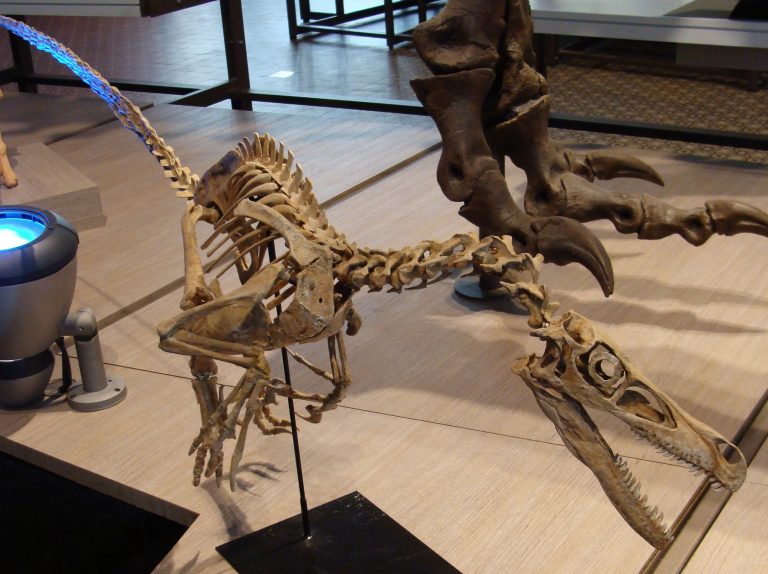
Velociraptor mongoliensis
Velociraptor mongoliensis
A turkey-sized feathered dromaeosaurid predator of the Gobi Desert, renowned for its hyperextensible sickle-shaped second toe claw and acute binocular hunting vision.

Archaeopteryx lithographica
Archaeopteryx lithographica
The historic transitional fossil bridging non-avian feathered theropods and modern birds, possessing feathered wings alongside toothed jaws and a bony tail.
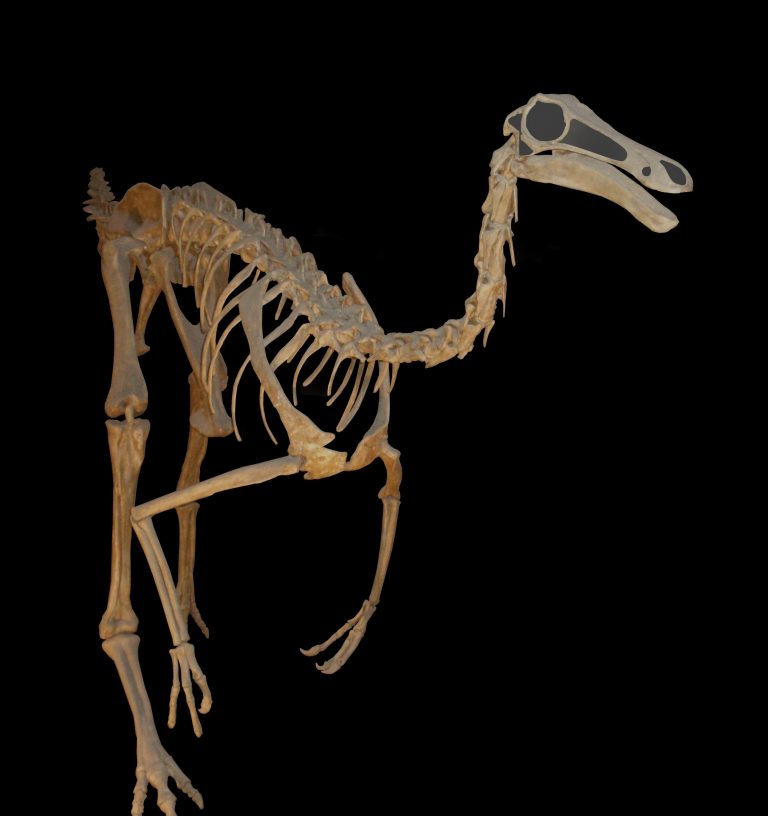
Gallimimus bullatus
Gallimimus bullatus
A fleet-footed ostrich-mimic theropod with a toothless keratinous beak suited for omnivorous grazing on vegetation, seeds, and small wetland invertebrates.
Related Paleontological Dispatches
Dinosaur News This Month: What Paleontologists Just Announced
Welcome to the October 2026 edition of Paleontological Dispatches, your curated, scientifically verified monthly roundup of what researchers…
The 10 Biggest Dinosaur Discoveries of the Last 5 Years
The last five years (2021–2026) represent one of the most prolific and intellectually transformative golden ages in the…

Why It Can Take 20 Years to Name a New Dinosaur
Whenever headlines announce that paleontologists have unveiled a spectacular new dinosaur species, the public naturally envisions a researcher…