Giganotosaurus: The Giant Predator of Patagonia
A forensic biomechanical evaluation of Giganotosaurus carolinii: analyzing its 13-meter body length, slicing carcharodontosaurid dentition, and how its predatory anatomy compares to Tyrannosaurus rex.

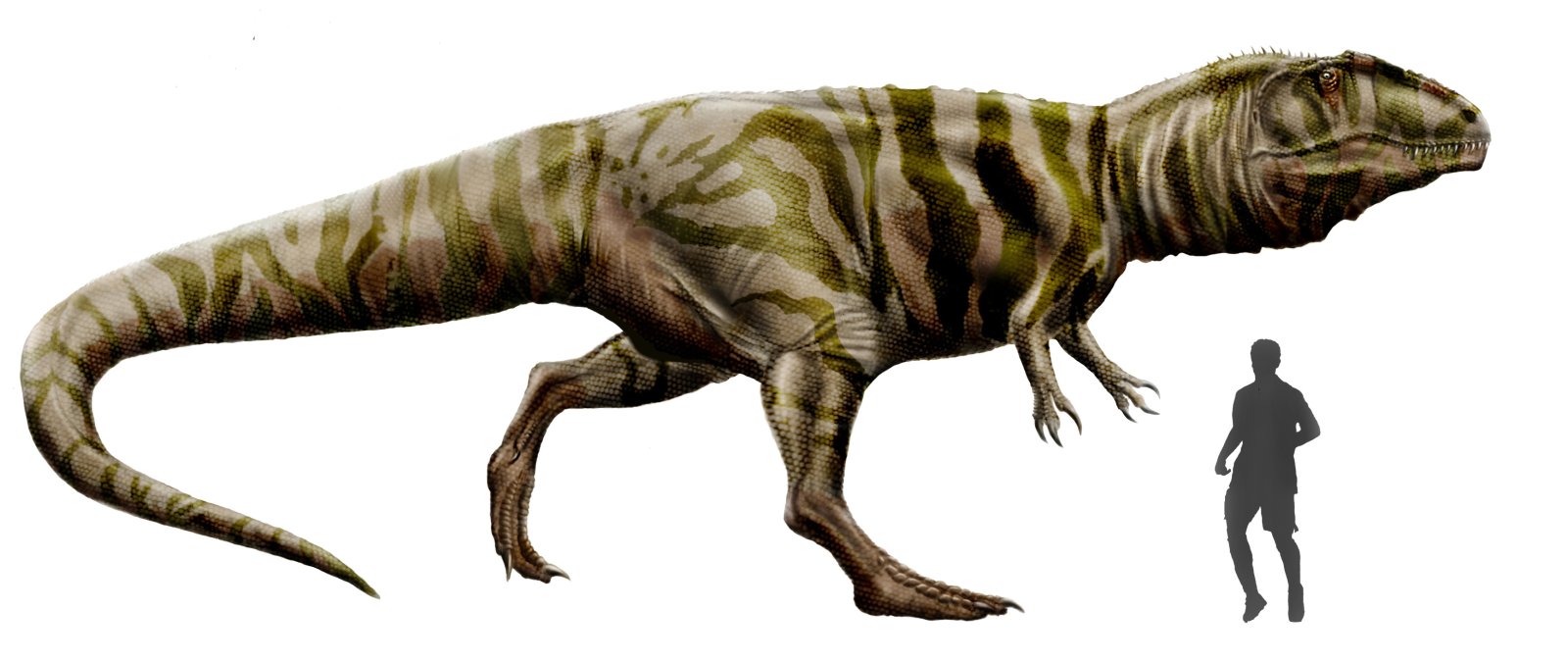
When Argentine paleontologists Rodolfo Coria and Leonardo Salgado announced the discovery of Giganotosaurus carolinii in 1995, the announcement sent shockwaves through the global scientific community. For nearly ninety years, North America’s Tyrannosaurus rex had stood uncontested as the heaviest and longest predatory dinosaur recognized by science. Emerging from the Cenomanian-aged sandstones of Patagonia, Giganotosaurus shattered that monopoly, revealing a predator with a skull over 1.5 meters long and an estimated body length approaching 13 meters (43 feet). Yet in popular media, sensational claims quickly declared Giganotosaurus the undisputed “T. rex killer.” Modern comparative anatomy reveals a far more nuanced evolutionary reality: rather than an upgraded tyrannosaur, Giganotosaurus was the pinnacle of a completely distinct theropod dynasty—the carcharodontosaurids—specialized not in crushing bones, but in slicing the titanic sauropods of prehistoric South America.
Key Paleontological Takeaways
- Length vs. Bulk: The holotype of Giganotosaurus carolinii (MUCPv-Ch1) measured approximately 12.2 to 12.5 meters (40 to 41 feet), with a larger referred jaw fragment (MUCPv-95) scaling up to 13.0 meters (42.6 feet). While slightly longer than an average T. rex, Giganotosaurus was more gracile, weighing 7.2 to 8.5 metric tons compared to T. rex‘s 8.8 to 9.5+ tons.
- Sauropod Slicing Dentition: Unlike the robust, bone-crushing railroad-spike teeth of tyrannosaurs, Giganotosaurus possessed laterally compressed, ziphodont (serrated, steak-knife-like) teeth designed to carve wide slashing wounds and inflict lethal blood loss.
- Patagonian Ecosystem: Discovered in the Candeleros Formation of Neuquén Province, Argentina (~99.6–97 Ma), Giganotosaurus was the apex predator of an ecosystem dominated by colossal titanosaur and rebbachisaurid sauropods.
- Brain and Senses: Endocranial CT reconstructions reveal a braincase less than half the volume of a comparably sized T. rex, with lateral monocular vision rather than forward-facing stereoscopic depth perception.
1. Discovery in the Neuquén Badlands: Rubén Carolini’s 1993 Breakthrough
In July 1993, amateur fossil hunter Rubén D. Carolini was exploring the arid, wind-swept badlands near Villa El Chocón in Neuquén Province, northwestern Patagonia, Argentina. Projecting from the reddish sedimentary rock of the Candeleros Formation, Carolini spotted a massive fossilized tibia (shin bone). Recognizing the significance of the find, he alerted vertebrate paleontologists Dr. Rodolfo Coria of the Carmen Funes Museum and Dr. Leonardo Salgado of the National University of Comahue.
The ensuing excavation yielded one of the most complete giant theropod skeletons ever recovered in the Southern Hemisphere: the holotype specimen MUCPv-Ch1, preserving roughly 70{349c590a1c7dba0edd042a8cb051d4ef440ecfe2a9c24e1b0b2c894f80ccce3c} of the skeleton, including an exceptionally preserved skull, vertebral column, pelvis, and both hindlimbs. In 1995, Coria and Salgado published the discovery in Nature, naming the genus Giganotosaurus (Greek for “giant southern lizard”) and dedicating the species name carolinii to its discoverer.
In 1998, paleontologist Jorge Calvo described a second, fragmentary specimen: MUCPv-95, an isolated left dentary (lower jaw bone) discovered in 1988 near the same locality. Measuring approximately 8{349c590a1c7dba0edd042a8cb051d4ef440ecfe2a9c24e1b0b2c894f80ccce3c} larger than the corresponding bone in the holotype, this specimen proved that mature individuals grew significantly larger than the initial discovery indicated.
2. The Size Debate: Was Giganotosaurus Really Bigger Than T. rex?
The headline that immediately circulated through the global press in 1995 was simple: “Scientists Find Dinosaur Bigger Than T. rex.” In the decades since, paleontologists have subjected the fossils to rigorous digital modeling, photogrammetry, and allometric scaling to determine whether that claim holds up.
A. Length Estimates
The holotype specimen MUCPv-Ch1 is estimated at 12.2 to 12.5 meters (40.0 to 41.0 feet) in total body length. Scaling from the larger dentary MUCPv-95 yields adult length estimates between 12.8 and 13.0 meters (42.0 to 42.6 feet). By comparison, the largest known Tyrannosaurus rex specimen (“Scotty”, RSM P2523.8) measures approximately 12.6 to 12.8 meters. Thus, in terms of linear tip-to-tail length, Giganotosaurus was slightly longer than an average T. rex and roughly matched or marginally edged out the largest known tyrannosaurs.
B. Body Mass and Robusticity
However, in biological science, animal size is defined primarily by body mass. In this metric, Tyrannosaurus rex maintains a clear advantage:
- Femoral Circumference Allometry: Using the universal tetrapod scaling equation developed by Campione and Evans (2012), the femur of the Giganotosaurus holotype (midshaft circumference 520 mm) yields an estimated body mass of approximately 7,200 to 8,200 kilograms (7.2 to 8.2 metric tons).
- Volumetric 3D Modeling: Computerized volumetric reconstructions incorporating convex hulls (Bates et al., 2009; Persons et al., 2020) yield mass estimates between 7,500 and 8,500 kilograms for the holotype, with the larger dentary individual approaching 8,800 kilograms.
- Comparison with T. rex: In contrast, identical allometric and volumetric modeling of T. rex specimens “Sue” (FMNH PR 2081) and “Scotty” yields masses of 8,460 to 9,500+ kilograms. T. rex possessed a substantially broader ribcage, an immensely wider pelvis, and thicker cortical limb bones, making it 1.0 to 1.5 metric tons heavier than Giganotosaurus.
3. Skull, Jaws, and Dentition: The Sauropod Slicing Machine
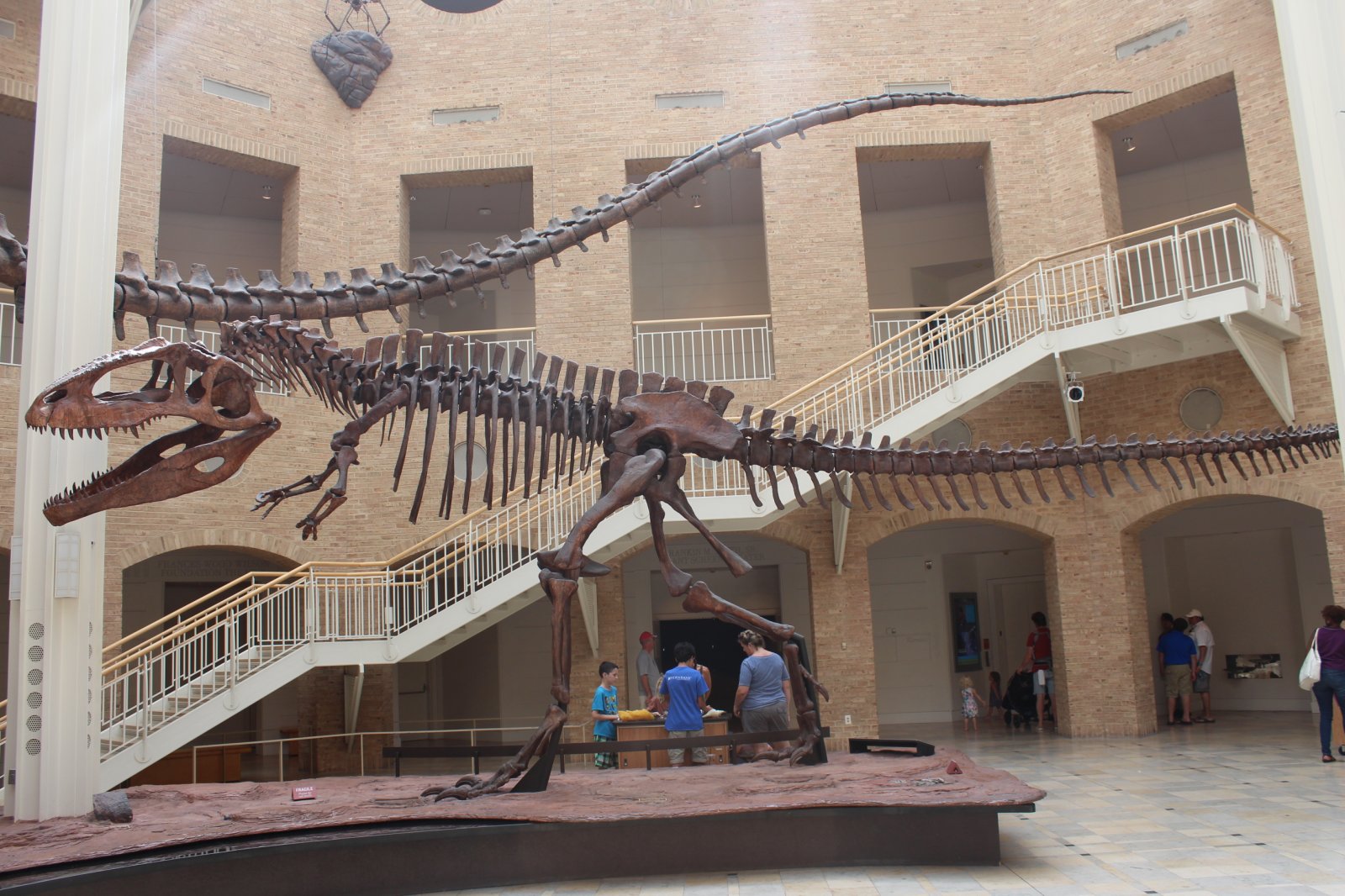
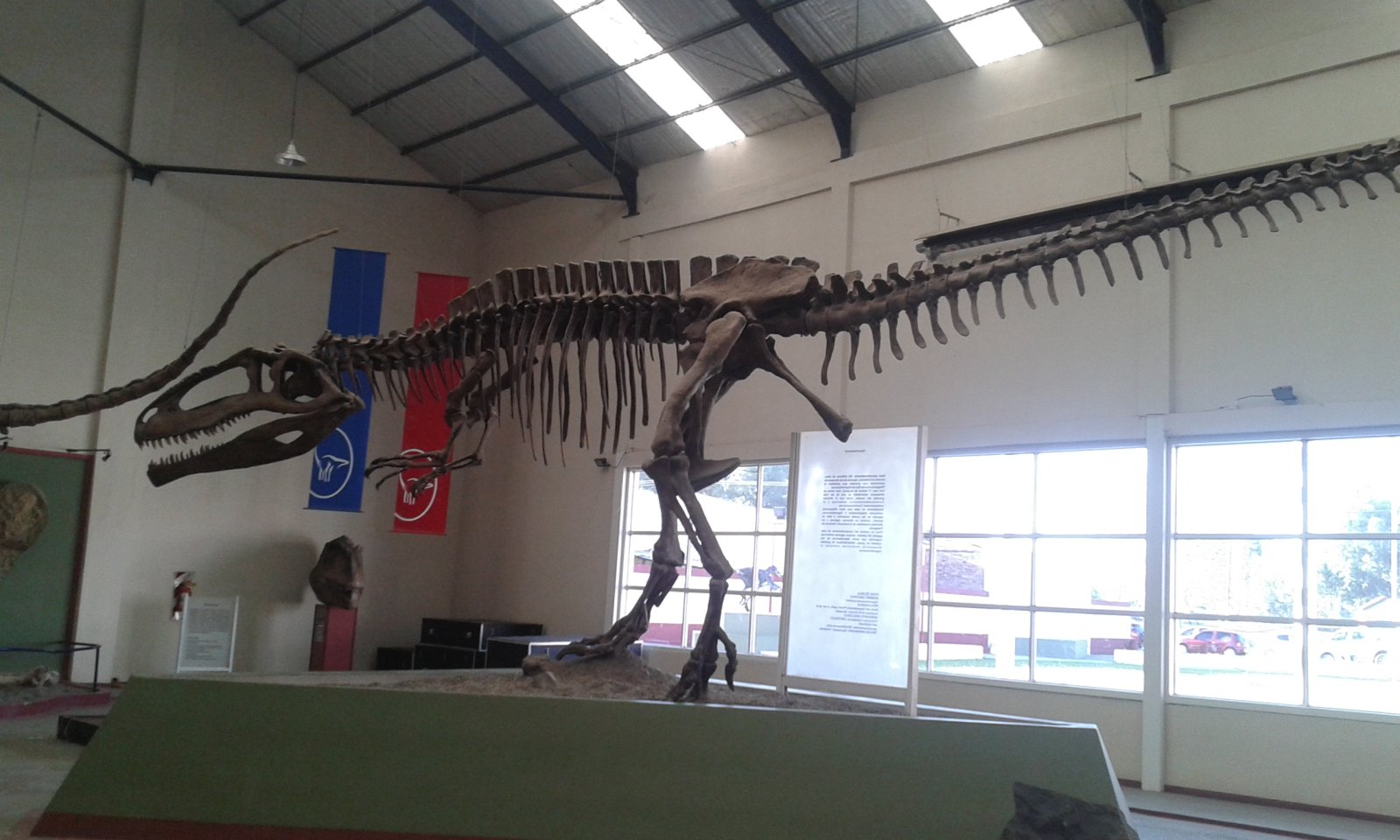
The most profound differences between Giganotosaurus and Tyrannosaurus reside in their cranial architecture and feeding ecology. While tyrannosaurs evolved as bone-crushing macropredators of armored ceratopsians and thick-skinned hadrosaurs, Giganotosaurus evolved as an open-flesh slicer tailored for hunting sauropods.
A. Cranial Dimensions and Lightening Windows
Initial reconstructions by Coria and Salgado estimated the skull of Giganotosaurus at 1.53 meters, and later revisions by Calvo and Coria (1998) stretched that estimate to 1.80 meters. Modern phylogenetic audits by Carrano et al. (2012) and Novas et al. (2013) reconstruct the true cranial length between 1.53 and 1.63 meters (5.0 to 5.3 feet)—still noticeably longer than the largest T. rex skulls (~1.50 m).
Despite its length, the skull of Giganotosaurus was exceptionally lightweight. It was perforated by cavernous antorbital fenestrae (skull openings) and thin bony struts. The skull was laterally compressed (narrow side-to-side), functioning as a tall, blade-like shear rather than a broad, reinforced battering ram.
B. Ziphodont Dentition and Bite Mechanics
The teeth of Giganotosaurus were up to 20 centimeters (8 inches) long including the roots, but were completely different in morphology from those of T. rex:
- Steak-Knife Morphology: The teeth were strongly compressed laterally, curved backward, and lined along both carinae (edges) with microscopic serrations (denticles). This ziphodont anatomy is identical to that seen in modern Komodo dragons and ancient carnosaur theropods.
- Slashing Kinetics: Biomechanical finite element analysis reveals that while the skull could not withstand extreme torsional (twisting) stress or deliver bone-pulverizing forces, it was perfectly adapted for high-speed slashing bites. With an estimated bite force between 10,000 and 18,000 Newtons, Giganotosaurus drew its jaws across soft tissue like an industrial saw, carving massive lacerations that triggered rapid hypovolemic shock in giant sauropods like Andesaurus.
4. Ancient Patagonia: The Candeleros Ecosystem
To understand why Giganotosaurus grew so colossal, one must examine its prehistoric ecosystem. During the early Cenomanian stage of the Late Cretaceous (~99.6 to 97 million years ago), South America was an isolated island continent. The Candeleros Formation in northern Patagonia represented a dynamic, semi-arid lowland floodplain crossed by seasonal braided rivers, bordered by araucaria conifers, cycads, and ginkgo groves.
In this ecosystem, herbivores achieved immense proportions:
- Andesaurus delgadoi: A basal titanosaur sauropod measuring 15 to 18 meters in length and weighing over 15 metric tons.
- Limaysaurus tessonei: A rebbachisaurid sauropod with tall dorsal spines, providing abundant biomass for apex carnivores.
- Ecological Competition: Giganotosaurus shared its habitat with medium-sized abelisaurid theropods (such as Ekrixinatosaurus) and primitive crocodylomorphs, but stood as the unchallenged apex macropredator of the region.
Because sauropods were so colossal that no single carnivore could tackle an adult through blunt force alone, carcharodontosaurids like Giganotosaurus and its later relative Mapusaurus evolved slicing dental batteries that allowed them to strip chunks of flesh from sauropods, potentially hunting in loose social mobs or targeting juvenile and weakened individuals.
5. Giganotosaurus vs. T. rex: Two Evolutionary Apex Philosophies
The table below provides an objective, peer-reviewed comparison contrasting the anatomical systems of these two mega-theropods:
| Trait / Anatomical System | Giganotosaurus carolinii | Tyrannosaurus rex |
|---|---|---|
| Geographic & Temporal Origin | Patagonia, Argentina (~99.6–97 Ma, Cenomanian) | Western North America (~68–66 Ma, Maastrichtian) |
| Total Body Length Range | 12.2 – 13.0 m (40–42.6 ft) | 12.2 – 12.8 m (40–42 ft) |
| Estimated Adult Body Mass | 7.2 – 8.5 metric tons | 8.8 – 9.5+ metric tons |
| Skull Construction | Long (~1.6 m), narrow, lightweight, large fenestrae | Broad (~1.5 m), heavily fused nasals, deep jaw |
| Dentition & Killing Strategy | Laterally compressed, serrated ziphodont flesh-slicers | Thick, oval bone-crushing railroad-spike teeth |
| Estimated Bite Force | 10,000 – 18,000 Newtons | Up to 57,000 Newtons |
| Forelimb Anatomy | Robust arms with 3 functional clawed digits | Dramatically reduced arms with 2 functional digits |
| Vision & Stereoscopy | Monocular lateral vision (~20° binocular overlap) | Stereoscopic depth perception (>55° binocular overlap) |
Common Misconceptions About Giganotosaurus
- Misconception 1: “Giganotosaurus was the undisputed biggest carnivorous dinosaur of all time.”
- While slightly longer than typical tyrannosaurs, Giganotosaurus was exceeded in linear length by Spinosaurus (~14–15 m) and was substantially outweighed by Tyrannosaurus rex (~8.8–9.5+ t). It was the largest carcharodontosaurid, but not the heaviest theropod.
- Misconception 2: “Giganotosaurus fought T. rex in prehistoric times.”
- This popular cinematic trope (featured in Jurassic World Dominion) is physically impossible. Giganotosaurus lived in South America roughly 97 million years ago, whereas T. rex lived in North America 66 million years ago. They were separated by an ocean and over 30 million years of evolutionary time.
- Misconception 3: “Giganotosaurus had tiny, vestigial arms like T. rex.”
- Unlike tyrannosaurids, which experienced extreme forelimb reduction, carcharodontosaurids retained well-developed, muscular pectoral girdles and three-clawed forelimbs capable of grasping and holding struggling prey.
Frequently Asked Questions
How big was Giganotosaurus?
Adults reached between 12.2 and 13.0 meters (40 to 42.6 feet) in total body length, stood approximately 3.9 meters (13 feet) tall at the hips, and weighed between 7.2 and 8.5 metric tons (roughly 15,800 to 18,700 pounds).
Was Giganotosaurus bigger than T. rex?
Giganotosaurus was slightly longer than an average T. rex, but Tyrannosaurus rex was significantly bulkier and heavier, with greater bone density, thicker musculature, and an adult weight reaching 8.8 to 9.5+ metric tons.
What did Giganotosaurus eat?
Giganotosaurus preyed primarily on large sauropod dinosaurs inhabiting ancient Patagonia, including titanosaurs like Andesaurus and rebbachisaurids like Limaysaurus, utilizing its serrated teeth to slice flesh and cause rapid blood loss.
Did Giganotosaurus hunt in packs?
Direct evidence for pack hunting in Giganotosaurus itself is absent, as the holotype was found alone. However, its close relative Mapusaurus was discovered in a bonebed containing several individuals of various ages, suggesting that carcharodontosaurids may have formed loose, opportunistic hunting associations.
Where are Giganotosaurus fossils kept today?
The holotype skeleton (MUCPv-Ch1) is preserved in the Museo Municipal Ernesto Bachmann in Villa El Chocón, Neuquén, Argentina, with high-quality research casts displayed at the Carmen Funes Museum and institutions worldwide.
Final Takeaway: The Crown Jewel of South American Paleontology
Giganotosaurus carolinii is a monumental testament to the evolutionary power of Gondwanan dinosaurs. Reaching 13 meters in length and mastering the vast river floodplains of Cretaceous Patagonia, it perfected the carnosaur body plan—wielding a narrow, lightweight skull and serrated slicing teeth to conquer the largest herbivores that ever walked the continent. By viewing Giganotosaurus through the lens of its own unique predatory specialization rather than simple Hollywood comparisons, paleontology celebrates one of the true titans of deep time.
Peer-Reviewed Literature Cited
- Coria, R. A., & Salgado, L. (1995). A new giant carnivorous dinosaur from the Cretaceous of Patagonia. Nature, 377(6546), 224–226. doi:10.1038/377224a0
- Calvo, J. O., & Coria, R. A. (1998). New specimen of Giganotosaurus carolinii (Coria & Salgado, 1995), supports it as the largest theropod. Gaia, 15, 117–122.
- Carrano, M. T., Benson, R. B. J., & Sampson, S. D. (2012). The phylogeny of Tetanurae (Dinosauria: Theropoda). Journal of Systematic Palaeontology, 10(2), 211–300. doi:10.1080/14772019.2011.636676
- Novas, F. E., et al. (2013). Evolution of the carnivorous dinosaurs during the Cretaceous: The evidence from Patagonia. Cretaceous Research, 45, 174–215. doi:10.1016/j.cretres.2013.04.001
- Campione, N. E., & Evans, D. C. (2012). A universal scaling relationship between body mass and proximal limb bone dimensions in quadrupedal and bipedal terrestrial tetrapods. BMC Biology, 10, 60. doi:10.1186/1741-7007-10-60
- Blanco, R. E., & Mazzetta, G. V. (2001). A new approach to evaluate the cursorial ability of the giant theropod Giganotosaurus carolinii. Acta Palaeontologica Polonica, 46(2), 193–202.
- Bates, K. T., et al. (2009). Estimating mass properties of dinosaurs using laser imaging and 3D computer modelling. PLOS ONE, 4(2), e4532. doi:10.1371/journal.pone.0004532
Scientific Sources & Peer-Reviewed Literature

Referenced Dinosaur Species 3 species
Tyrannosaurus rex
Tyrannosaurus rex
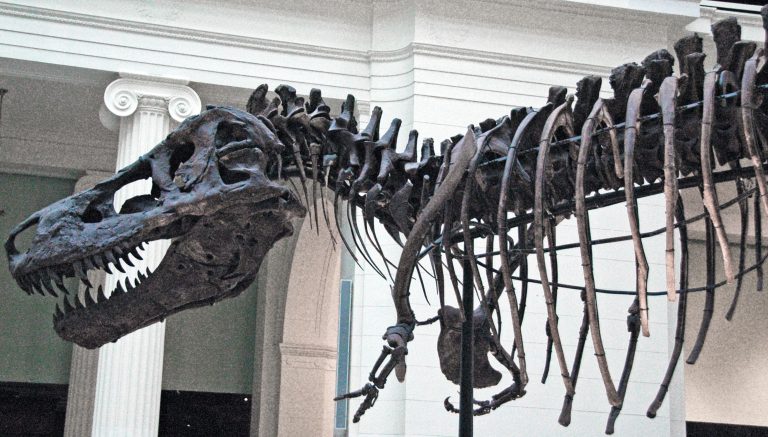
Tyrannosaurus rex was one of the largest terrestrial carnivores of all time, roaming western North America just prior to the Cretaceous-Paleogene extinction event. With an estimated bite force exceeding 35,000 Newtons and acute stereoscopic vision, it sat uncontested at the apex of its ecosystem.
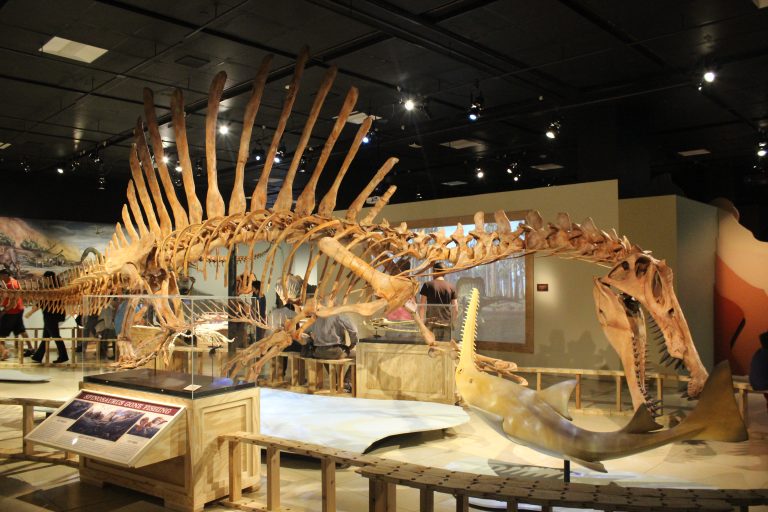
Spinosaurus aegyptiacus
Spinosaurus aegyptiacus
A colossal semi-aquatic predatory theropod equipped with a massive dorsal neural sail, crocodyliform snout, and paddle-like tail adapted for pursuing giant Cretaceous fish.
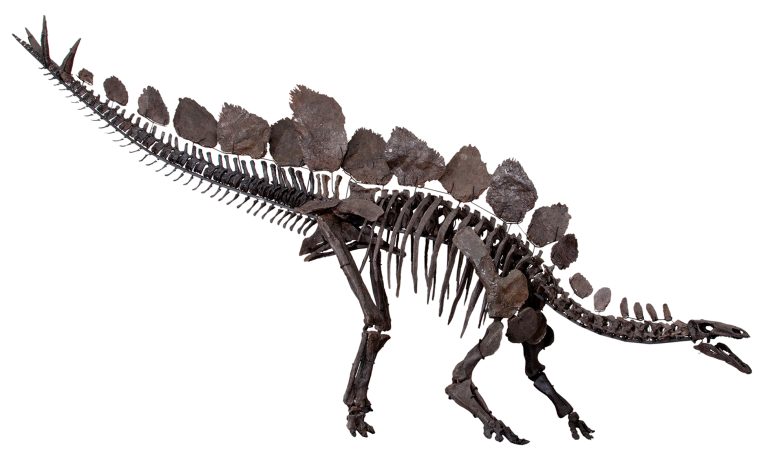
Stegosaurus stenops
Stegosaurus stenops
An iconic plated herbivore possessing alternating osteodermal dorsal plates for thermoregulation or display and four lethal tail spikes (thagomizer) for active defense.
Related Paleontological Dispatches
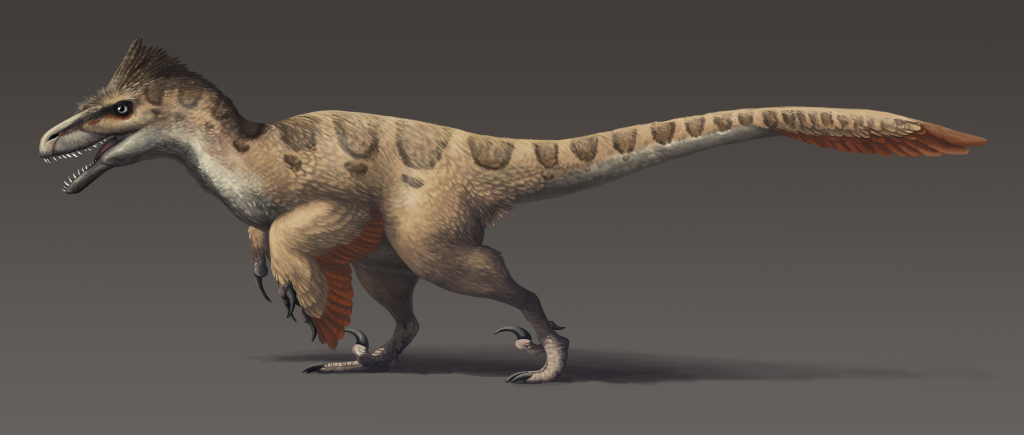
Utahraptor: The Giant Raptor Found in Utah
When pop culture introduced the world to the terrifying “raptors” of cinema in 1993, audiences were terrified by…
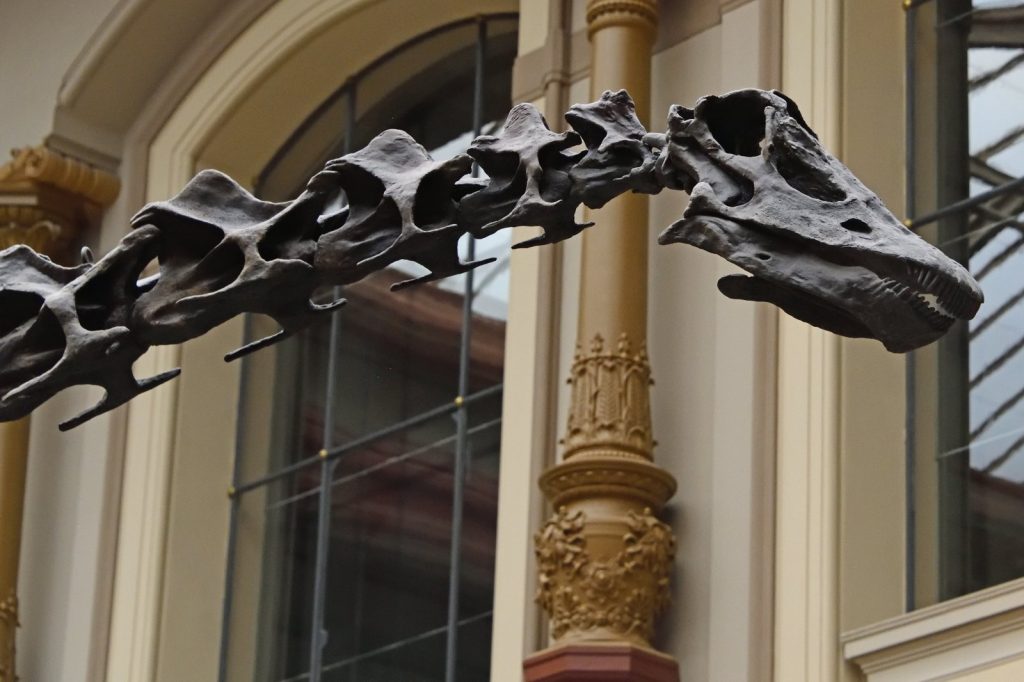
Diplodocus: How Long Was This Whip-Tailed Giant?
Among all the colossal dinosaurs unearthed from the Late Jurassic rock strata of western North America, Diplodocus has…

Ankylosaurus: The Living Tank of the Cretaceous
In the final stages of the Late Cretaceous, western North America was home to some of the most…