DINOSAUR COMPARISON

Compare the giants.

Examine two prehistoric species side by side. Compare physical scale, geological epochs, dietary strategies, locomotion, and fossil formations based on documented paleontological evidence.

DINOSAUR A
Triceratops horridus

Triceratops horridus

Triceratops horridus

Cretaceous
DINOSAUR B
Brachiosaurus altithorax

Brachiosaurus altithorax

Brachiosaurus altithorax

Jurassic

Overview of Triceratops horridus and Brachiosaurus altithorax

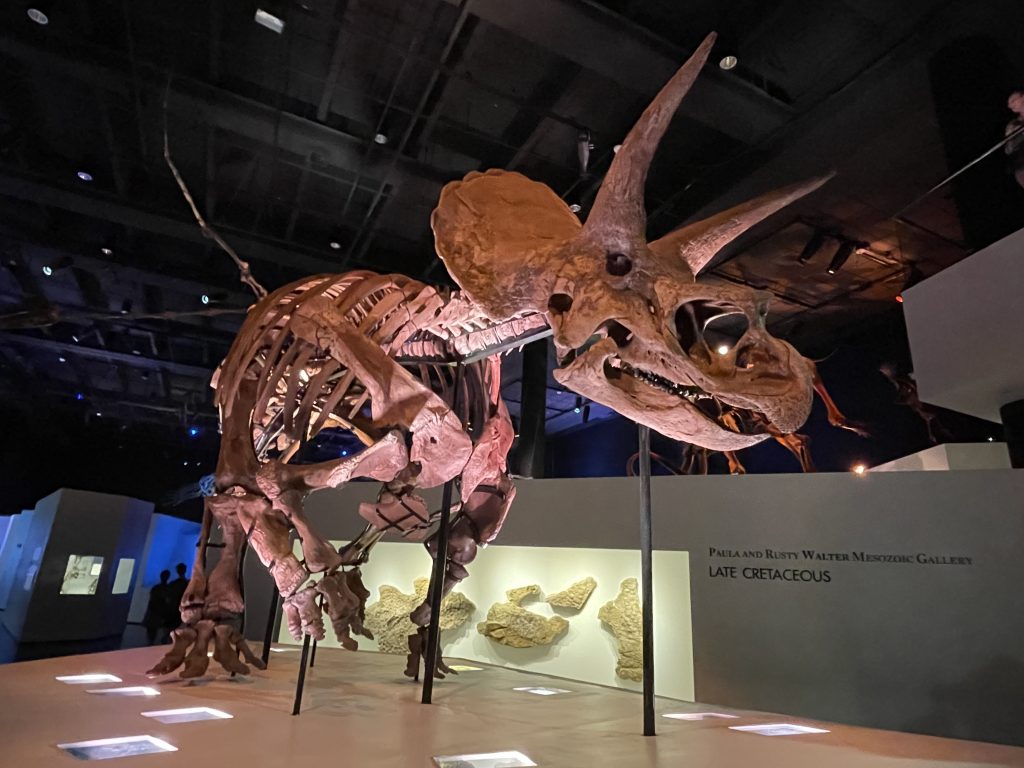
Mounted fossil skeleton of Triceratops horridus (specimen HMNS 2006.1743.00, "Lane") at the Houston Museum of Natural Science. HMNS 2006.1743.00 ("Lane")
Cretaceous Herbivore North America

Triceratops horridus

Triceratops horridus • “Three-horned face with roughness”

Triceratops horridus is one of the most recognizable horned dinosaurs. Equipped with two brow horns measuring up to 1 meter in length, a shorter…

Outdoor cast skeleton mount of Brachiosaurus altithorax (specimen FMNH P 25107) at the Field Museum of Natural History, Chicago. FMNH P 25107 mount
Jurassic Herbivore North America

Brachiosaurus altithorax

Brachiosaurus altithorax • “Arm lizard with high chest”

A colossal macronarian sauropod with disproportionately long forelimbs and an elevated neck built for high-canopy conifer browsing during the Late Jurassic.

Curatorial Analysis Summary

Triceratops horridus lived during the Cretaceous, while Brachiosaurus altithorax inhabited the Jurassic. They were separated by roughly 82 million years of deep time and never encountered one another in the ancient world. Both species shared a herbivore diet, occupying comparable trophic levels in their respective food webs. Based on available fossil estimates, Brachiosaurus altithorax was larger than Triceratops horridus in both overall length and estimated body mass (approximately 5.83× heavier and 2.89× longer). Estimates vary between individual specimens.

Physical Proportions

Visual Size & Mass Comparison

Anatomical dimensions compared on a shared proportional baseline against an adult human (1.8 m / 5.9 ft).

Ground Reference Baseline Snout Alignment Origin 1.8 m Triceratops horridus: 9m Brachiosaurus altithorax: 26m
Adult Human: 1.8 m (5.9 ft) — Scale reference
Triceratops horridus: 9 m (29.5 ft) length • 3 m height
Brachiosaurus altithorax: 26 m (85.3 ft) length • 12 m height

Total Body Length

Snout to tail tip
A 9 m 29.5 ft
B 26 m 85.3 ft

Brachiosaurus altithorax was longer by approximately 17 m.

Standing / Hip Height

Ground to highest point
A 3 m 9.8 ft
B 12 m 39.4 ft

Brachiosaurus altithorax stood taller by approximately 9 m.

Estimated Body Mass

Adult weight estimate
A 6 t 6,000 kg
B 35 t 35,000 kg

Brachiosaurus altithorax had a greater estimated mass by 29 tonnes.

Scientific Evaluation

Brachiosaurus altithorax was generally larger

Based on available fossil estimates, Brachiosaurus altithorax was larger than Triceratops horridus in both overall length and estimated body mass (approximately 5.83× heavier and 2.89× longer). Estimates vary between individual specimens.

Paleontological Note on Mass Estimates: Dinosaur body weights are derived through volumetric laser scanning and femoral circumference scaling equations. Because soft tissue does not fossilize directly, mass values carry statistical margins of uncertainty and represent scientific estimates rather than exact weights.

Head-to-Head Synthesis

Key Differences at a Glance

Direct answers to the most important comparative questions about how these two prehistoric species differed.

Overall Physical Scale

Based on available fossil estimates, Brachiosaurus altithorax was larger than Triceratops horridus in both overall length and estimated body mass (approximately 5.83× heavier and 2.89× longer). Estimates vary between individual specimens.

Diet & Trophic Guild

Both species shared a herbivore diet, occupying comparable trophic levels in their respective food webs.

Geological Era & Epoch

Triceratops horridus lived during the Cretaceous (Late Cretaceous, 68–66 Ma), while Brachiosaurus altithorax lived during the Jurassic (Late Jurassic, 154–150 Ma).

Geographic Provenance

Fossils of Triceratops horridus were recovered from Western North America (Colorado, Montana, South Dakota, Wyoming, Alberta), whereas Brachiosaurus altithorax was discovered in Colorado, Utah, Wyoming (Morrison Formation).

Locomotion & Stance

Triceratops horridus had a quadrupedal locomotion, contrasted with Brachiosaurus altithorax which had a quadrupedal stance.

Did They Coexist?

Triceratops horridus and Brachiosaurus altithorax did NOT live at the same time. They were separated by an immense temporal gulf of approximately 82 million years. Brachiosaurus altithorax lived and went extinct tens of millions of years before Triceratops horridus ever evolved.

Systematic Records

Comprehensive Scientific Comparison Matrix

Side-by-side catalog of verified anatomical measurements and geological records.

Scientific comparison matrix between Triceratops horridus and Brachiosaurus altithorax
Scientific Parameter A Triceratops horridus B Brachiosaurus altithorax
Scientific Binomial Triceratops horridus Brachiosaurus altithorax
Name Meaning “Three-horned face with roughness” “Arm lizard with high chest”
Taxonomic Clade / Group Ceratopsians Sauropods
Geological Period Cretaceous Jurassic
Fossil Time Range Late Cretaceous, 68–66 Ma Late Jurassic, 154–150 Ma
Diet & Trophic Guild Herbivore Herbivore
Maximum Length 9 m (29.5 ft) 26 m (85.3 ft)
Standing / Hip Height 3 m (9.8 ft) 12 m (39.4 ft)
Estimated Body Mass 6 tonnes (6,000 kg) 35 tonnes (35,000 kg)
Locomotion / Stance Quadrupedal Quadrupedal
Geographic Localities Western North America (Colorado, Montana, South Dakota, Wyoming, Alberta) Colorado, Utah, Wyoming (Morrison Formation)
Geological Formation Hell Creek Formation, Lance Formation, Denver Formation Morrison Formation
Discovery History John Bell Hatcher (1888); described by Othniel Charles Marsh (1889) (1888) Historical holotype
Chronostratigraphy & Deep Time

Geological Timeline Comparison

Visualizing both species across the 186-million-year span of the Mesozoic Era.

A Triceratops horridus Late Cretaceous, 68–66 Ma
B Brachiosaurus altithorax Late Jurassic, 154–150 Ma
Paleobiology & Time

Did They Live Together?

They did not overlap

Separated by Millions of Years

Triceratops horridus and Brachiosaurus altithorax did NOT live at the same time. They were separated by an immense temporal gulf of approximately 82 million years. Brachiosaurus altithorax lived and went extinct tens of millions of years before Triceratops horridus ever evolved.

Deep-time perspective: Triceratops horridus and Brachiosaurus altithorax were separated by approximately 82 million years. A visitor encountering one would have had no concept of the other.

Paleoenvironments

Ancient Habitats & Geological Formations

Comparing the rock strata, paleoclimates, and ancient landscapes where their fossils were entombed.

Triceratops horridus
Primary Fossil Formation Hell Creek Formation, Lance Formation, Denver Formation
Geographic Localities

Western North America (Colorado, Montana, South Dakota, Wyoming, Alberta)

Paleocontinent / Realm

North America

Brachiosaurus altithorax
Primary Fossil Formation Morrison Formation
Geographic Localities

Colorado, Utah, Wyoming (Morrison Formation)

Paleocontinent / Realm

North America

Stratigraphic Synthesis:

Scientific Methodology

Paleontological Uncertainty & Scientific Notes

Understanding Paleontological Comparison Data

Direct comparisons between extinct animals are inherently shaped by the incomplete nature of the fossil record. Skeletal dimensions reflect holotype or well-preserved paratype specimens, but individual ontogenetic age, sexual dimorphism, and intraspecific variation all influence the true living size of any prehistoric animal.

Body mass estimates shown above represent calculated averages from published volumetric models and biomechanical limb scaling. As modern synchrotron imaging and 3D digital skeletal mounts advance, museum measurements are continually refined.

Continue Exploring the Prehistoric World

Browse all verified dinosaur species in the directory, trace deep-time epochs on the timeline, or explore our educational learning guides.

Choose Dinosaur

Selecting specimen for comparison